
How to Search Minnesota Court Records
Minnesota Court Records Online, known as MCRO, searches public District Court case information and selected documents from all 87 counties. It offers Case, Document, Hearing, and Judgment searches without registration. Remote access is broad but not complete. Some case types and documents are restricted, older material may not be electronic, and certified copies are unavailable through MCRO. Appellate cases use the separate P-MACS public search. The filing county's Court Administration remains the source for certified, archived, paper, or missing documents.
Begin with the case number when possible. Minnesota case numbers use letters, numbers, and hyphens, and MCRO rejects spaces. A party-name search is exact, so try the middle name both included and omitted, use the asterisk wildcard after at least two characters, or select Sounds Like. A pending criminal case will not appear through a defendant-name Case or Hearing Search before a qualifying conviction. Search by case number, citation number, attorney name, or attorney bar number instead. An empty name result is not proof that no case exists.
- Open MCRO and choose Case, Document, Hearing, or Judgment Search based on the needed record.
- Enter the no-space case number, or search a public case by party name and a broad court location.
- Review the county, case type, status, parties, events, hearings, dispositions, and available public PDFs.
- If the result is missing or incomplete, choose the filing county from the Minnesota county directory.
- Ask that county's Court Administration for the specific document and state whether a plain, certified, or exemplified copy is required.
The Minnesota Judicial Branch is the official statewide starting point for court locations, forms, and access guidance. Its public interface is reflected in the image below.
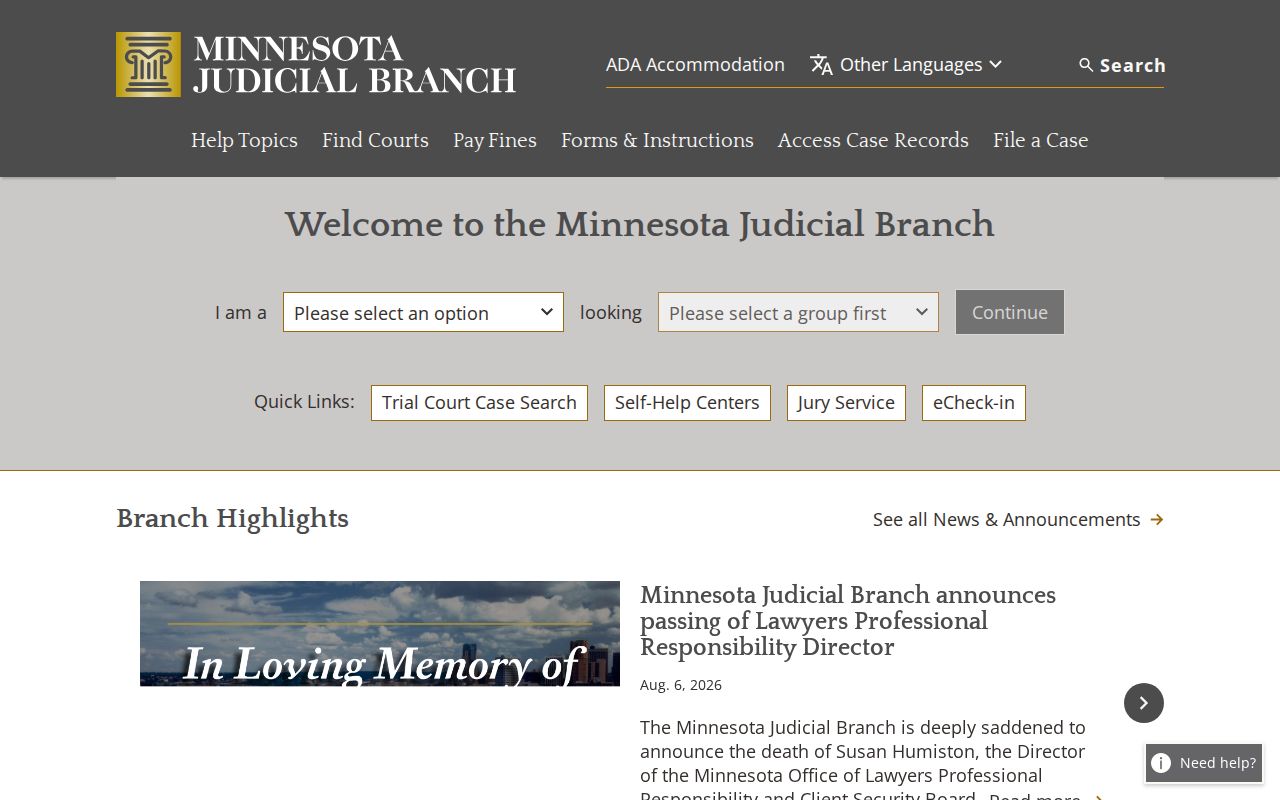
The branch entry page connects statewide case tools with local court offices, which is the same two-part route a complete Minnesota records search requires.
Inside Minnesota's Court System
Minnesota has one unified, three-level Judicial Branch. Minnesota District Court is the general trial court and sits in every county. It handles civil, criminal, family, juvenile, probate, housing, traffic, and conciliation matters through case divisions rather than separate county or municipal court tiers. Ten judicial districts organize trial administration, but the file stays linked to the county and location where the action began. The Minnesota court system overview explains the hierarchy and each court's record path.
The Minnesota Court of Appeals is one statewide intermediate court with 19 judges, not ten geographic appellate courts. Most District Court appeals go there as of right. The seven-justice Minnesota Supreme Court is the final state court and generally chooses whether to review Court of Appeals decisions, while specified matters receive direct or automatic review. Minnesota has no separate criminal high court. Trial records stay in District Court even after a notice of appeal, while appellate filings appear in P-MACS.
Appeals path: Minnesota District Court › Minnesota Court of Appeals › Minnesota Supreme Court
| Court | Jurisdiction | Case Types |
|---|---|---|
| Minnesota Supreme Court | Statewide final review and branch administration | Selected appeals, first-degree murder review, lawyer regulation, specified original matters |
| Minnesota Court of Appeals | Statewide intermediate review | Nearly all District Court appeals, plus specified agency decisions |
| Minnesota District Court | General trial jurisdiction in every county | Civil, criminal, family, probate, juvenile, housing, traffic, and conciliation cases |
Browse Minnesota Record Types
Minnesota District Court creates the ordinary trial record for nearly every case category. Civil files may include complaints, service, motions, orders, judgments, and satisfactions. Criminal files track the complaint or citation, appearances, pleas, motions, disposition, sentence, and appeal. Family records cover divorce, custody, support, and protective matters, but confidential information forms and child-related details may be withheld. Juvenile, adoption, civil commitment, and some victim information receive special protection. Each category uses the same statewide branch, yet access depends on the file, document class, and filing county.
- Criminal records contain the court's full filed case history, which differs from a compiled BCA criminal history.
- Civil records include general claims, conciliation cases, housing actions, money judgments, and related orders.
- Family and divorce records are District Court files, while marriage certificates come from county license offices.
- Probate records document estate administration, wills filed in a case, appointments, inventories, claims, and closing orders.
- Traffic records show citation and court outcomes, while DVS maintains the separate driver record.
What Minnesota Court Records Show
A Minnesota case detail can identify the case number, title, court location, classification, filing date, status, judge, parties, lawyers, hearing schedule, event history, disposition, and available public documents. Criminal cases may add charge statute, offense level, offense date, plea, sentence, probation, restitution, and disposition dates. Civil judgments can identify creditor, debtor, docketing, and satisfaction events. A balance displayed online may change with interest or later payment, so Court Administration should confirm a current payoff.
| Field | What It Shows |
|---|---|
| Case Number | Encodes the court location, case classification, year, and sequence; preserve hyphens and omit spaces in MCRO. |
| Filing Date | The date the action entered District Court, not necessarily the date of the underlying event. |
| Parties | Public names and roles such as plaintiff, defendant, petitioner, or respondent, with counsel when accessible. |
| Charges or Claim | The alleged offense and statute, or the civil or family basis for relief. An allegation is not a judgment. |
| Disposition | How a charge, claim, or case ended, including dismissal, plea, verdict, judgment, or another result. |
| Sentence or Judgment | The enforceable order, which may include custody, probation, fine, restitution, money relief, or nonmonetary terms. |
- Register of actions
- The chronological docket of filings, hearings, orders, and other case events.
- Certified copy
- A copy authenticated by Court Administration for uses that require official court certification.
- Expungement
- A legal process that seals qualifying records from ordinary public access; it is not the same as physical destruction.
Search Minnesota Statewide Systems
Several important Minnesota records sit outside the court case system. The BCA Public Criminal History Search compiles public Minnesota conviction data held for the public retention period, while a District Court file shows one prosecution in detail. The DOC Offender Locator covers people under Minnesota Department of Corrections jurisdiction, not people held only in a county jail. MyDVS supplies certified driving records and license services, not the pleadings and docket from a traffic prosecution.
Marriage and divorce illustrate the office split. The Minnesota Office of Vital Records expressly does not record either one. The Minnesota Official Marriage System indexes records from participating counties, but the issuing county provides the certificate. District Court Administration in the granting county provides a divorce decree. The BCA public predatory-offender search covers specified noncompliant registrants, not every registrant and not general Minnesota warrants. For custody routes, compare county jail records with Minnesota inmate records.
| System | What It Holds | Run By |
|---|---|---|
| DOC Offender Locator | People under state corrections jurisdiction, placement, sentence, and release fields | Minnesota Department of Corrections |
| BCA Public Criminal History | Public Minnesota conviction history, distinct from a complete county case file | Bureau of Criminal Apprehension |
| MyDVS and DVS records | Driver status and certified driving history | Minnesota DPS Driver and Vehicle Services |
| MOMS | Marriage index for participating counties; certificates remain with counties | Participating county local registrars |
Minnesota Court Records Access Laws
Minnesota uses two related but distinct access regimes. Judicial case and branch administrative records follow the Minnesota Rules of Public Access to Records of the Judicial Branch. State and local executive agencies, including police, sheriffs, counties, DOC, DVS, and BCA, generally follow the Minnesota Government Data Practices Act. A court request sent as a generic Chapter 13 demand may be redirected because the Judicial Branch applies its own rules. Remote access can also be narrower than courthouse access, so a document may be public at a terminal without being downloadable from home.
The Minnesota Data Practices Office publishes guidance for executive-agency requests. The image below comes from that official office and represents the separate process used for government data outside the court branch.
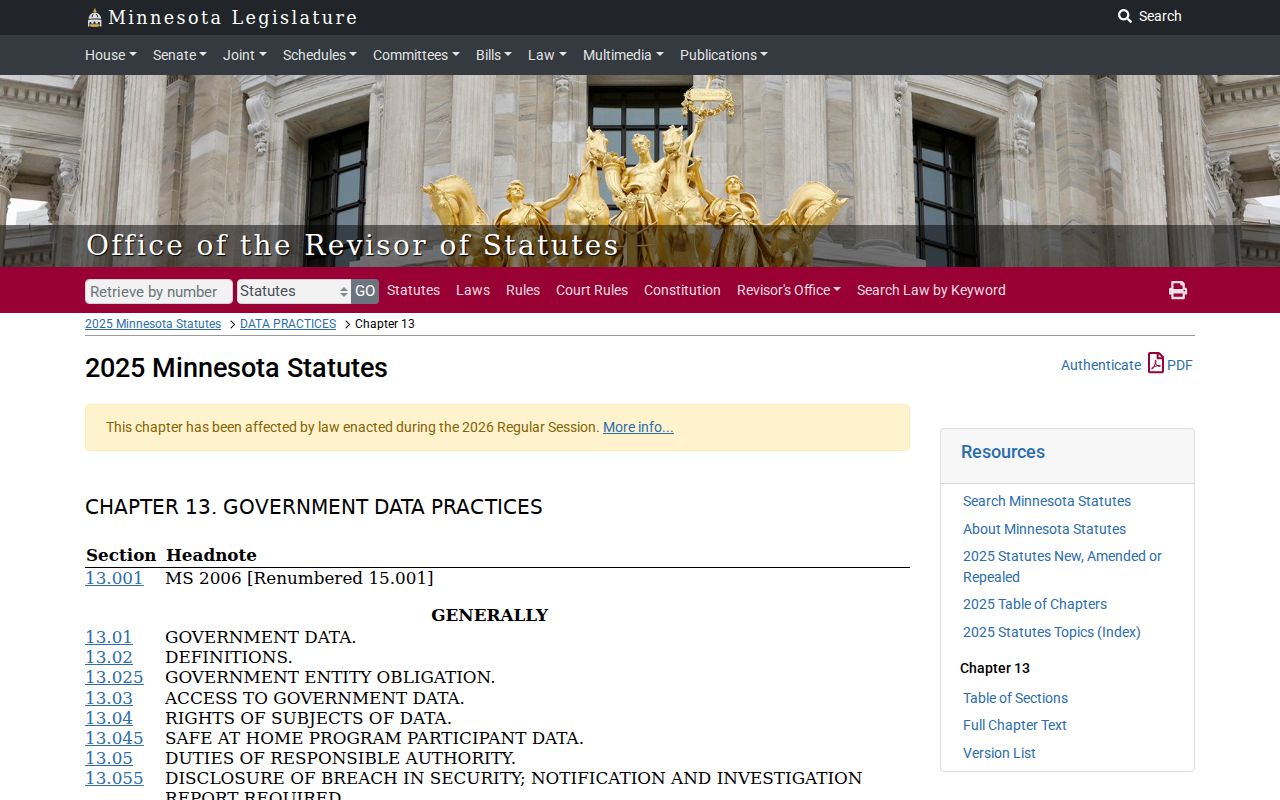
Correctly identifying the record owner determines which Minnesota access law, request channel, and appeal route applies.
Key Statutes:
Minnesota Rules of Public Access classify court case and administrative records and set remote-access limits.
Minn. Stat. Chapter 13 governs classification and access for state and local executive-agency data.
Minn. Stat. § 13.82 distinguishes public law-enforcement response data from protected investigative data.
Minn. Stat. § 609A.03 sets the petition, notice, hearing, and order process for criminal-record expungement.
Restricted Minnesota Court Records
Public status does not make every document public. Adoption files are confidential. Juvenile court and BCA juvenile history have special statutory limits. Civil commitment files can contain protected medical reports. Confidential addresses, Social Security numbers, financial accounts, juror data, and protected victim or minor information are removed or placed on restricted forms. A public docket can therefore exist while a particular exhibit, report, or identifier remains unavailable. Parties seeking their own restricted material should follow Court Administration's identity and authorization process.
Expungement seals qualifying judicial and, when the order reaches them, executive-branch criminal records from ordinary public access. A petition under Chapter 609A is filed in the District Court county where the case was resolved and must identify the case, disposition, history, legal basis, and affected agencies. Notice and a hearing may be required. Automatic-expungement provisions apply to certain records, but eligibility, waiting periods, and scope differ. A sealed result disappearing from MCRO does not mean every authorized criminal-justice trace was destroyed.
Find Minnesota Records by County
Every Minnesota District Court case is associated with a filing county, even though MCRO searches statewide. Local Court Administration supplies certified copies, paper archives, file-specific fee quotes, and help locating material absent from the remote portal. County sheriffs also hold jail and local warrant data, while county offices issue marriage certificates. The six most populous counties below represent the state's largest metro and regional systems. The full directory reaches all 87 county records sites.
Hennepin County
Minneapolis · Fourth Judicial District and the branch's largest urban records center
Ramsey County
Saint Paul · Second Judicial District with specialized Housing Court operations
Dakota County
Hastings · First Judicial District with several south-metro service locations
Anoka County
Anoka · Tenth Judicial District and a large north-metro caseload
Washington County
Stillwater · Tenth Judicial District east-metro court administration
St. Louis County
Duluth · Sixth Judicial District with a broad multicourthouse service area
Browse the full directory of all 87 Minnesota counties to open the court records site for any county.
Check Minnesota Court Records Fees
MCRO case searches and public document views are free, but a downloaded PDF is not a certified court record. Plain, certified, and exemplified copies require Court Administration to identify the document, count pages, and apply the correct authentication charge. Minnesota does not provide one dependable statewide total for every copy request. Local schedules and the requested format matter. The ordinary civil first-paper statute contains a $310 state component, but law-library and other authorized surcharges can increase the filing-counter total. It should never be quoted as the final local filing fee without confirmation.
| Item | Statewide Basis or Amount |
|---|---|
| MCRO public search | Free; certification is unavailable online |
| Plain court copy | Per-page or local branch schedule; request a page-count quote |
| Certified or exemplified copy | Copy charge plus certification or authentication; local quote required |
| Ordinary civil first paper | $310 statutory component under Minn. Stat. § 357.021, plus applicable surcharges |
| BCA public online criminal history | Free web search; other products use the current BCA form fee |
| Certified DVS record | $10 for one's own record; $10.50 for another person's record, subject to access rules |
Minnesota publishes official court forms through its statewide forms library, shown below. Current forms matter because fees, service rules, and required fields can change.
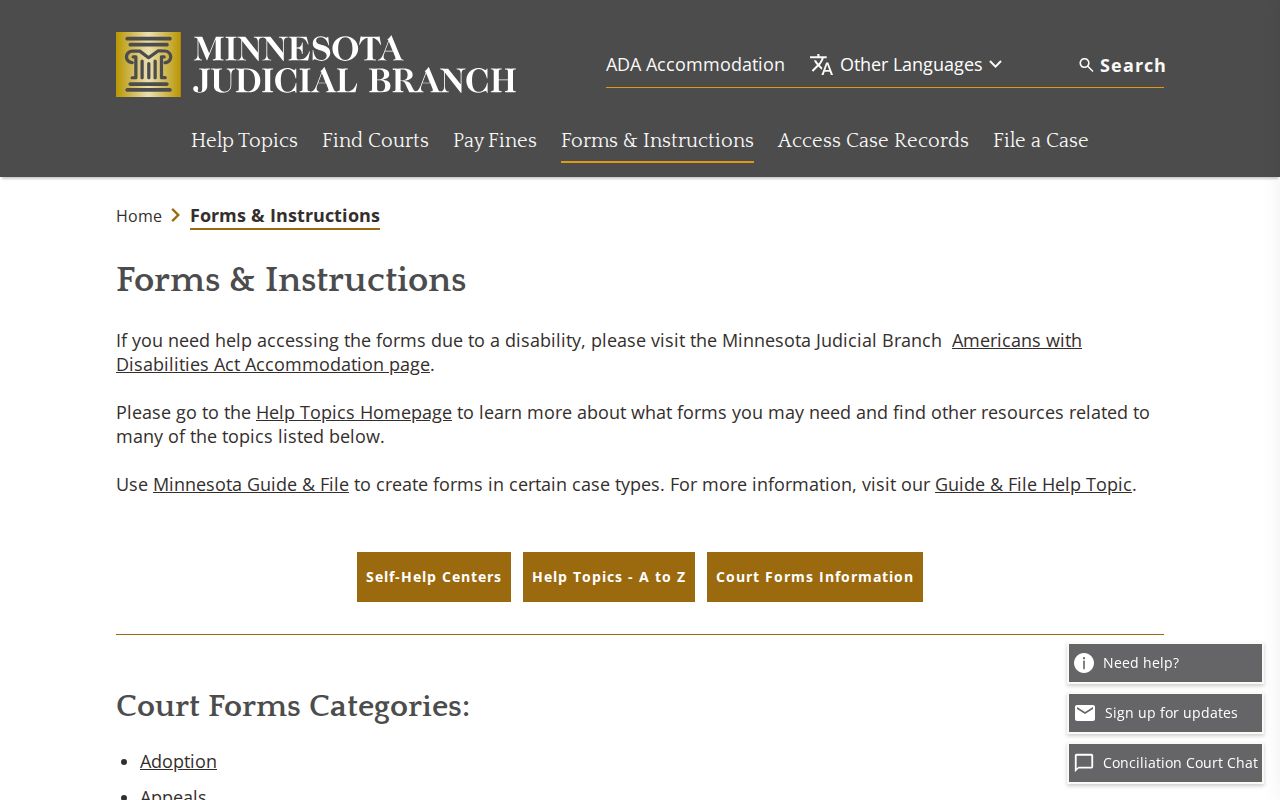
The form library supports filing and request preparation, while the filing county supplies the final payment amount and accepted method.
Interpret Minnesota Court Records
Read a Minnesota case from the case header through the register of actions, then confirm the final disposition. A complaint, citation, or indictment records an accusation. It does not establish guilt. A plea or verdict can support a conviction, but each charge may end differently. “Dismissed with prejudice” ordinarily bars refiling of that claim, while “without prejudice” can permit a legally timely new filing. A continuance moves a hearing. A stay can delay an action or sentence component. The exact order controls, so a short docket label should not replace the filed document.
Case status is broader than any single event. A file may be closed, reopened, transferred, or stayed. In criminal matters, a stayed imposition and a stayed execution have different legal effects. Minnesota also uses “supervised release” for DOC community custody after prison; casually calling every such status parole can be misleading. For money judgments, docketing and satisfaction events show legal milestones, but interest can change the current balance. Ask Court Administration to confirm payoff or certification.
Charges versus convictions: A filed charge states what the government alleges. A conviction requires a guilty plea, guilty verdict, or qualifying judgment.
Verify Minnesota Record Accuracy
A record can be absent from MCRO because the search terms are too narrow, a pending criminal name-search restriction applies, the case type or document is not remotely accessible, the file was expunged, retention rules removed older material, or the record never became electronic. Online events can also lag a recent courtroom action. Search alternate name forms and the no-space case number before drawing a conclusion. Then use a courthouse MNPAC terminal for a more complete public electronic view or contact the filing county for paper, archive, and certified material.
Corrections follow the record owner. Court Administration addresses a District Court docket or document. BCA handles a criminal-history record. DVS handles a driving record. A county sheriff handles its incident, jail, or warrant data. Provide the subject, case or incident number, disputed field, and supporting document rather than asking an unrelated office to change another agency's system.
Note: Confirm critical facts with filing-county Court Administration before relying on a remote Minnesota court record for an official purpose.
Minnesota Court Records Questions
Is MCRO the official statewide search?
Yes. Minnesota Court Records Online is the Judicial Branch's remote public system for District Court case data and selected documents from every county. It does not provide certified copies, every document class, or the fullest courthouse view. Appellate cases use P-MACS. Local Court Administration supplies certified documents and helps with older, paper, or unavailable trial material.
Why is a pending criminal case missing?
MCRO does not return a pending criminal matter through a defendant-name Case or Hearing Search until a conviction as defined by Minnesota law. Dismissed and continued-for-dismissal matters count as pending for that restriction. Search by case number, citation number, attorney name, or attorney bar number. Contact the filing county if the correct identifier still produces no result.
Are marriage and divorce records statewide?
No single Minnesota office issues both. MOMS searches an index from participating counties, but the issuing county supplies the marriage certificate. A divorce is a District Court case, and Court Administration in the county that granted it supplies the decree. The Minnesota Department of Health Office of Vital Records does not record marriages or divorces.
Does a court record include a full background check?
No. A District Court record documents one filed case. The BCA criminal-history repository compiles qualifying Minnesota criminal-history data under its own rules and retention periods. Jail, DOC, federal, out-of-state, and sealed information follow other systems. Match the search tool to the record needed and never treat a case filing as proof of a conviction.
Where can certified Minnesota records be ordered?
Contact District Court Administration in the filing county for certified court documents. State whether the request is for a plain, certified, or exemplified copy and identify the case number, parties, county, and exact document. Marriage certificates go to the issuing county office. Other agency records, such as criminal history or driving history, must come from BCA or DVS.
Can all public records be downloaded?
No. Minnesota distinguishes public access from remote access. A courthouse MNPAC terminal can provide a more complete public electronic view than MCRO. Some files remain on paper, and certain public documents cannot be downloaded remotely because of case type, document rules, retention, or digitization. Confidential and sealed information remains restricted even at the courthouse.