
Search Minnesota Traffic Court Records
Minnesota Court Records Online, or MCRO, searches many public District Court cases from all 87 counties. Use Citation Number or Case Number when possible. A defendant-name search may be blocked while a criminal traffic matter is pending, but the citation, case, or attorney route may still work. MCRO is free and requires no registration. Its remote view does not include every public file or older paper item, and it cannot certify a document, pay a fine, schedule a hearing, or file a response.
Keep the full number exactly as printed, including hyphens. If the citation is new, the issuing agency may not have transmitted it yet. Agency transmission, case creation, payment or hearing, disposition, and any required report to DVS happen in sequence. A short lag does not mean the citation vanished.
- Read the citation for its District Court location, citation number, response deadline, and appearance instructions.
- Open MCRO and use Citation Number. Use the exact case number instead if it is already known.
- Check the charge, court location, deadline, hearing, plea, disposition, fine, surcharge, and compliance events.
- Contact filing-county Court Administration before paying or asking for a hearing when instructions are unclear.
- Order a plain or certified copy from Court Administration when official proof is required.
Minnesota Courts Handling Traffic Cases
Minnesota District Court is the state's only ordinary trial-court tier. It handles state traffic offenses, local ordinance citations prosecuted in court, DWI, and criminal vehicular matters. Minnesota has no separate municipal, justice, or county-court tier. A city may still run parking or civil administrative enforcement outside the court system. The office printed on the notice identifies the right channel.
The Minnesota Judicial Branch traffic guidance explains payment and contest routes. Court Administration in the filing county controls copies, hearing questions, and the local paper file. A criminal traffic case remains in District Court but can create a second administrative track at DVS.
- Minnesota District Court
- State traffic, ordinance, DWI, and criminal vehicular cases appear through MCRO and filing-county Court Administration.
- City administrative office
- Parking or civil administrative notices not filed in court follow the office and process printed on the notice.
- DPS Driver and Vehicle Services
- License status and reported driving history come through MyDVS or the official records request form, not the court case.
Minnesota Traffic Record Categories
A Minnesota ticket's category affects its court process and whether a conviction is reported to the driving file. The court record preserves what was filed and how it ended. DVS applies licensing law to reported outcomes. Minnesota does not use a simple consumer-facing points total like some states, so a driver should not infer license status from a home-made point count.
- Moving violations: Offenses tied to vehicle operation can affect the Minnesota driving file after disposition.
- Equipment and registration: Lighting, equipment, registration, and similar charges create a case when filed in District Court.
- Parking and administrative notices: A city channel may control payment and review when no court case was filed.
- CDL matters: Commercial drivers face added reporting and disqualification rules and should assess consequences before paying.
- DWI and criminal vehicular cases: These are criminal matters with court and DVS consequences on separate tracks.
A crash report, traffic citation, driving record, and civil injury lawsuit are also separate records. Use MCRO for a filed case, DVS or the investigating agency for crash material, and DVS for the driver file.
What Minnesota Traffic Records Show
A Minnesota District Court traffic file tracks the charge and court events. It may show financial entries, but Court Administration remains the source for a current balance because payments, collections, and later compliance can change. Read each count's disposition rather than relying only on overall case status.
| Field | What It Shows |
|---|---|
| Citation and case numbers | Identifiers connecting the issued ticket to the District Court file. |
| Offense and authority | Offense date, statute or ordinance, description, level, and issuing agency. |
| Court events | Location, deadline, plea, hearings, continuances, and filed orders. |
| Disposition | Conviction, dismissal, amendment, or another result for each count. |
| Financial entries | Fine, surcharge, payment, collection, and compliance events. |
| License-related entries | Court events that do not replace the current DVS license record. |
A closed Minnesota case may contain different results on separate counts. Check the plea and disposition for each charge, then contact Court Administration if the current balance or satisfaction is not clear.
Minnesota Citation Search Fields
Citation Number gives the most direct Minnesota traffic lookup. Case Number is a strong alternative after filing. A name may produce common-name matches and may be unavailable for a pending criminal citation. Court Location narrows results, while statewide search helps when the county is uncertain.
| Search Field | Type | Required | Notes / Format |
|---|---|---|---|
| Citation Number | Text | Yes for direct lookup | Enter exactly. |
| Case Number | Text | Alternative | Letters, numbers, and hyphens; no spaces. |
| Court Location | Selector | Helpful | Choose statewide or the citation county. |
| Name | Text | Alternative | Pending criminal name restrictions apply. |
| Search / Clear | Buttons | Not applicable | Run or reset the query. |
For a recent citation with no match, allow time for filing and call the court shown on the ticket. Do not treat an empty name search as proof that no traffic case exists.
Resolve a Minnesota Traffic Ticket
Read the citation before acting. Some Minnesota offenses are payable, while others require appearance. Where official instructions say payment resolves the charge as a guilty plea or conviction, paying can affect insurance, immigration, a CDL, or driving privileges. Ask the court for the total fine and surcharge, deadline, and any proof-of-correction option. Court staff can explain process but cannot advise which plea to enter.
A contest requires an official hearing request before the deadline. An informal call does not cancel a court date. Preserve the ticket, photos, dashcam material, witness contacts, and proof of repair, insurance, or registration. Confirm whether the hearing is remote or in person. Minnesota supports no blanket promise of deferred adjudication or a defensive-driving dismissal.
- Identify the offense, court, deadline, and appearance rule.
- Obtain the current total before choosing payment.
- Request a hearing through the official court channel to contest.
- Appear with evidence or obtain an approved continuance.
- After disposition, verify the court balance and DVS status separately.
Minnesota Traffic Record Access
Judicial files chiefly follow the Minnesota Rules of Public Access. MCRO provides remote access to many records, while a free MNPAC terminal at a District courthouse can show more. Filing-county Court Administration handles mailed requests, old paper, certification, and a public copy request. The Minnesota county directory routes to that office. An officer's incident material or crash data follows the responsible agency's Chapter 13 process instead.
Two access rules: Court records follow Judicial Branch public-access rules. DVS records require consent or a permitted purpose for another person's protected driver data under federal and state privacy law.
Redacted identifiers, sealed material, juvenile data, and protected medical or victim information do not become public merely because a related Minnesota traffic docket appears online.
Minnesota DVS Driver Records
The Minnesota Department of Public Safety Driver and Vehicle Services maintains the statewide driver file. MyDVS lets an account holder request a certified driving record and view license status. Form PS2502 provides a mail or in-person route. It asks for the driver's name, birth date, Minnesota license or ID number, desired product, requester details, signature, and payment. The DVS Records Unit phone is 651-296-2940.
When District Court reports a qualifying conviction, DVS updates the driver file under licensing law. The update may follow the court disposition, so MCRO and DVS can briefly differ. DVS evaluates suspensions, revocations, and disqualifications rather than assigning a simple public points total. A paid court entry does not establish valid privileges, and DVS reinstatement does not remove the court conviction.
The official DVS fee page describes current products. A noncertified five-year record is convictions-only and narrower than a certified product. Another person's record requires consent or a permissible purpose.
The state driver channel is documented by the official Minnesota DVS source.
This agency view marks the separate source for Minnesota driving history and license status.
The online request route appears in the official MyDVS services page.
MyDVS serves the driver-record task, while MCRO remains the Minnesota court-case search.
Minnesota Court and Driver Records
The Minnesota court file answers what was charged, what happened at hearings, and how each count ended. The driver file answers what DVS received and the current licensing result within that product's scope. Corrections go to the office that owns the wrong field. Court Administration corrects its docket; DVS handles driver-file errors.
| Record Type | Source | What It Shows | How to Access |
|---|---|---|---|
| Minnesota District Court traffic record | Filing-county Court Administration | Citation, charge, hearing, plea, disposition, fine, and order | MCRO, MNPAC, or county office; correction through Court Administration |
| Minnesota driving record | DPS Driver and Vehicle Services | License status, reported convictions, issuance history, suspension, revocation, or disqualification within scope | MyDVS or PS2502; correction through DVS |
If the two systems disagree, compare the disposition and posting dates before seeking a correction. Report a court error to Court Administration and a driver-file error to DVS.
Minnesota CDL Traffic Records
A Minnesota CDL holder should review court and licensing consequences before paying. Commercial convictions can trigger added federal and state reporting or disqualification rules. No dismissal or diversion should be assumed to prevent reporting. The written court disposition and DVS file answer separate questions, and official proof may require certified documents from both custodians.
Drivers should identify whether the charge arose in a commercial vehicle and ask DVS which record product proves current status. A local payment option does not override state or federal CDL reporting duties.
Minnesota DWI Record Tracks
DWI creates a dual track. Minnesota District Court decides the criminal charge and sentence, while DVS handles implied-consent or other administrative action against driving privileges. Plate impoundment or vehicle forfeiture can add related proceedings. A dismissal in one track does not automatically end the other. Deadlines to challenge administrative action can be short.
For the filed accusation and criminal case path, consult Minnesota arrest and charge records.
Minnesota Traffic Case Outcomes
A prosecutor or judge decides an amendment, dismissal, trial result, payment plan, or qualifying diversion under the actual case and current law. A payment plan changes collection terms but not necessarily the conviction or DVS consequence. Failure to appear in a criminal matter can produce a warrant. Minnesota's debt-based suspension practices have changed, so not every unpaid ticket should be called an automatic license suspension.
After any conditional outcome, read the final written disposition and verify that each task was completed. Do not assume course attendance, proof of correction, or a payment plan automatically prevents a report to DVS.
Minnesota Traffic Record Restrictions
Traffic records may be restricted by a sealing or expungement order when the case and statute qualify. Minnesota court files follow branch rules, and MCRO does not display sealed material. That does not mean every agency record was destroyed. The order defines its reach, and driver-file consequences must be checked with DVS rather than inferred from a missing court result. Juvenile, victim, medical, and protected identifier data may also be withheld or redacted.
A requester seeking restricted material may need party status, legal authority, or a court order. Public access and reuse are different questions, especially when a driver record contains information protected by the DPPA.
Minnesota Traffic Record Fees
Court fines are not copy fees. Minnesota Court Administration quotes plain pages, certification, archive retrieval, and delivery for the exact request. DVS charges by product and requester. These amounts reflect official research dated August 11, 2026; the current agency page and form control.
| Item | Amount |
|---|---|
| Plain traffic case copy | Per-page or local branch schedule; request a quote |
| Certified court copy | Copy plus certification charge; request a quote |
| DVS noncertified record | $9 own; $9.50 another |
| DVS certified record | $10 own; $10.50 another |
| Vehicle title history | $1 per printed page in addition |
The current fee channel is shown by the Minnesota DVS records fee source.
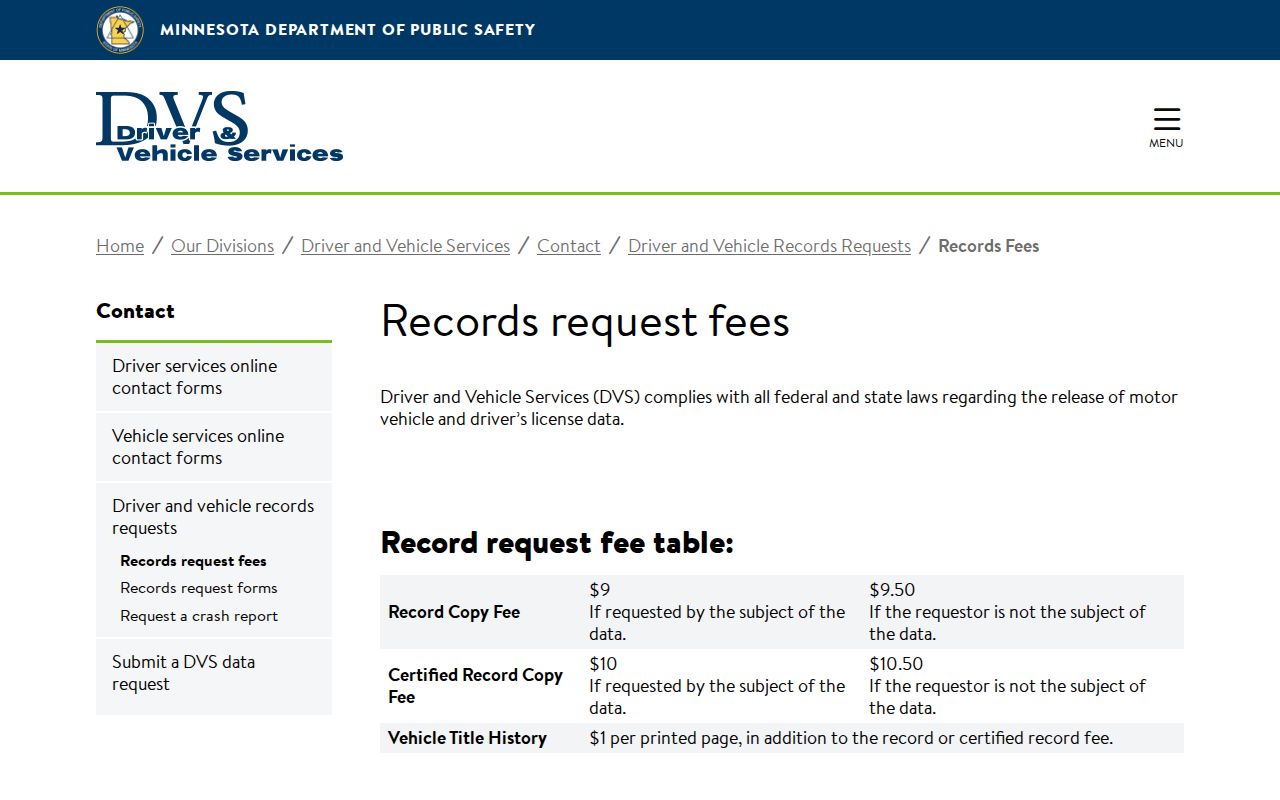
This official fee view helps distinguish the DVS product charge from a court fine or court-copy cost.
Note: Ask the citation county for a court-copy quote and DVS for the current product and privacy requirements.