
Minnesota Criminal Case Files
A Minnesota District Court criminal file begins when a complaint, citation, or indictment opens a prosecution. Court Administration maintains that file in the county where the case was brought. It is not split between elected county and district clerks. The record follows filed counts through hearings, motions, pleas, trial, disposition, sentence, probation activity, and appeal notices. Police reports and jail bookings come from executive agencies, while the court file shows what prosecutors filed and what judges ordered.
District Court is Minnesota's single ordinary trial-court tier. It hears felony, gross-misdemeanor, misdemeanor, petty-misdemeanor, and ordinance prosecutions. Minnesota has no separate municipal or justice-court layer. City cases that become court prosecutions are assigned to a county District Court location. An arrest record answers what law enforcement did; the filed arrest and charge record shows the accusation; the criminal case file adds the litigation and result.
Search Minnesota Criminal Records
Minnesota Court Records Online, or MCRO, provides free remote access to many public District Court case details and documents from all 87 counties. Remote access is narrower than courthouse access. A pending criminal case cannot be found by defendant name. Use the complete case number, citation number, or attorney name and bar number instead. The case number should contain no spaces. A recent complaint may also take time to reach the system.
- Open MCRO Case Search and accept its access terms.
- Enter the complete case or citation number for a pending matter. Use a careful name search for an eligible conviction record.
- Confirm the county, defendant, filed date, and CR case classification before opening details.
- Read every count, event, plea, disposition, and sentence. Do not rely only on the case-status label.
- Use the Minnesota county directory to reach filing-county Court Administration for a certified or unavailable document.
A MNPAC terminal at a District courthouse exposes a more complete set of public electronic information. Filing-county Court Administration also handles local paper, archive material, exhibits, certification, and corrections to the court source. Ask for a named document and docket date, whether its attachments are included, the copy type, total cost, and delivery method. A missing remote PDF may still be public at a courthouse.
Minnesota Criminal Case Flow
The date of arrest, complaint signature, court filing, first appearance, plea, disposition, and sentencing can all differ. Chronology matters. A prosecutor can decline a case, amend counts, or dismiss one count while another proceeds. Each step produces its own event or document, and an appeal creates a separate appellate case in P-MACS.
Case flow: Charges Filed › Arraignment › Pretrial › Plea or Trial › Disposition › Sentencing
| Stage | Minnesota Record Created |
|---|---|
| Charges filed | Complaint, citation, or indictment lists numbered counts, statutes, levels, and alleged facts. |
| First appearance | Entries address rights, counsel, release conditions, and bail. |
| Pretrial | Omnibus hearings, motions, evidence rulings, continuances, and amended counts enter the register. |
| Plea or trial | The file records a plea, court or jury verdict, dismissal, acquittal, or other result for each count. |
| Sentencing | Orders may show executed and stayed custody, jail credit, probation, fines, restitution, and conditions. |
Stayed adjudication, stay of imposition, and stay of execution do not mean the same thing. Read the actual order. Minnesota records use supervised release for DOC community custody, so that label should not be casually changed to parole.
Minnesota Criminal Record Fields
The MCRO register and public documents show the court's version of the prosecution. Presentation can vary with age, access status, and document availability, but these fields identify the file and explain its outcome.
| Field | What It Shows |
|---|---|
| Case number and county | The filing location, CR classification, year, and sequence used to request the source file. |
| Defendant and counsel | Public identity information, party role, attorneys, and bar numbers where displayed. |
| Count and statute | Count number, section and subdivision, offense title, level, and alleged offense date. |
| Plea | The defendant's response to each count, including later amended-count pleas. |
| Disposition | Dismissal, acquittal, conviction by plea or verdict, or another count-level result and date. |
| Sentence | Custody, stayed time, probation, fines, surcharge, restitution, credit, and conditions as ordered. |
| Events and hearings | The chronological register, scheduled proceedings, motions, orders, and public document links. |
Minnesota Charges and Convictions
A charge is an accusation. A conviction is a judgment based on a guilty plea or guilty verdict. Minnesota cases often contain several counts with different paths. The original count may be amended, one count may be dismissed under an agreement, and another may support conviction. A closed case label cannot resolve that detail.
| Question | Charge | Conviction |
|---|---|---|
| Meaning | Prosecutor or grand jury alleges an offense. | Court records guilt through plea or verdict. |
| Best source | Current complaint and count history. | Disposition and sentencing order. |
| BCA public search | Pending and nonconviction data are excluded. | Public conviction may appear during the statutory public window. |
Read the current complaint and every later event. A sheriff roster can display intake allegations before prosecutor review. It is not proof that the same count was filed or sustained.
Minnesota BCA Criminal History
The BCA Minnesota Public Criminal History Search is a compiled repository, not a substitute for an MCRO case file. Its ordinary public results cover public conviction information for 15 years after sentence completion. They can show the offense, offense date, conviction court and date, sentence, conviction level, and probation agency or place of confinement. Arrests, nonconviction cases, older completed convictions outside that window, and juvenile history are excluded from the public screen.
The BCA search uses first and last name, with middle name and date of birth as identity aids when offered. A name match is not proof of identity. Compare lawful identifiers, county, offense date, court, and the source disposition. The subject can follow the current official request form for a broader record about self. Authentication, fee, notarization, fingerprints, consent, and program rules depend on request type and must be checked on the current form.
The Minnesota Public Criminal History interface shows how the statewide conviction search differs from a court docket:
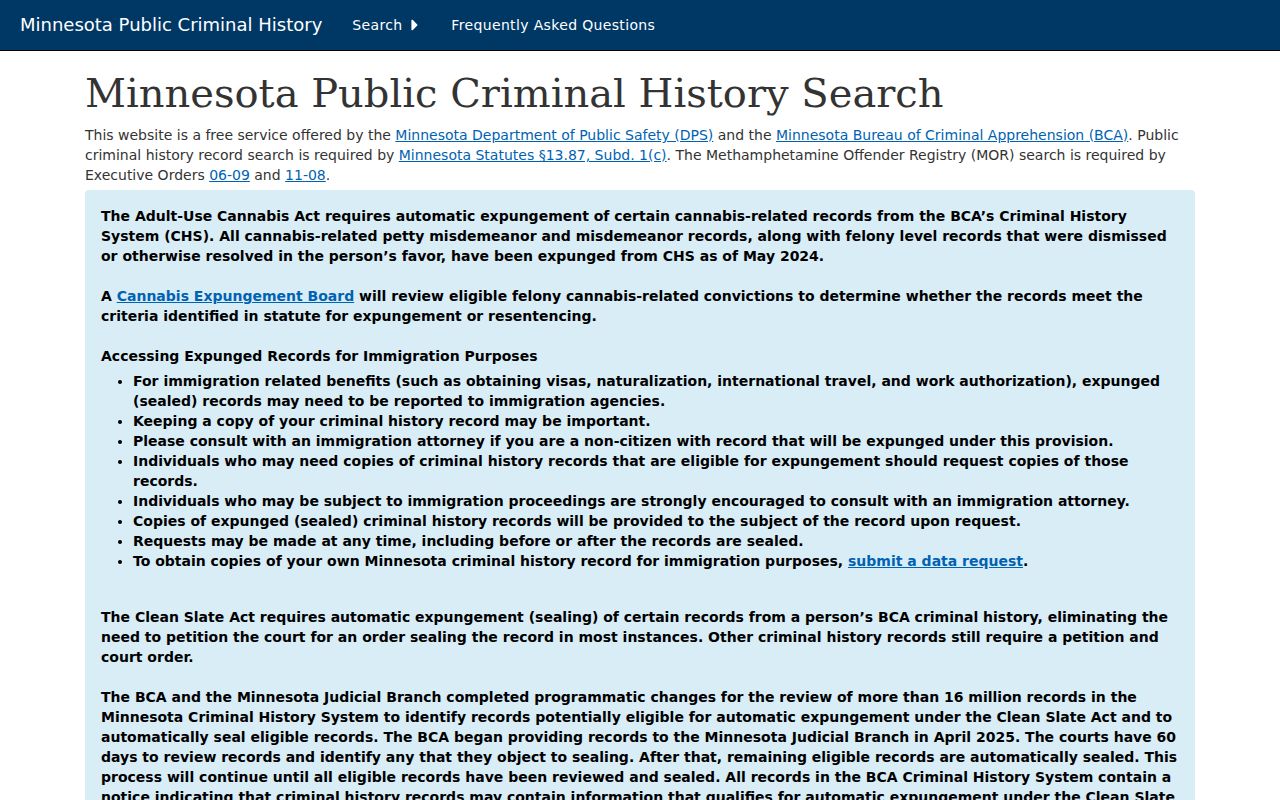
Use its candidates as leads, then obtain the underlying disposition from the filing county when proof of the court result is required.
Note: A lack of public BCA results does not prove that no arrest, nonconviction case, old conviction, or federal record exists.
Minnesota Sealed and Expunged Records
Expungement is Minnesota's legal process for sealing qualifying court and, where ordered, executive-branch criminal records from ordinary public access. It is not literal destruction. Eligibility and procedure can differ for resolved-in-favor matters, diversion outcomes, misdemeanors, gross misdemeanors, selected felonies, and automatic-expungement categories. The order controls which agencies and records are covered.
| Point | Restricted or Private Record | Expunged Record |
|---|---|---|
| Basis | Court rule, data classification, or specific sealing order limits access. | Statute or a Chapter 609A order seals qualifying records. |
| Public view | The case or document may be absent remotely or available only to authorized people. | Covered material is hidden from ordinary public portal and agency disclosure. |
| Government access | Authorized access follows the governing rule or statute. | Specified criminal-justice and background-check exceptions can remain. |
Minnesota Statutes section 609A.03 sets petition content, service, hearing, burden, and fee or waiver procedure. File in the District Court county where the case was resolved and identify affected agencies accurately.
The official Minnesota expungement procedure is reflected in the current statute:
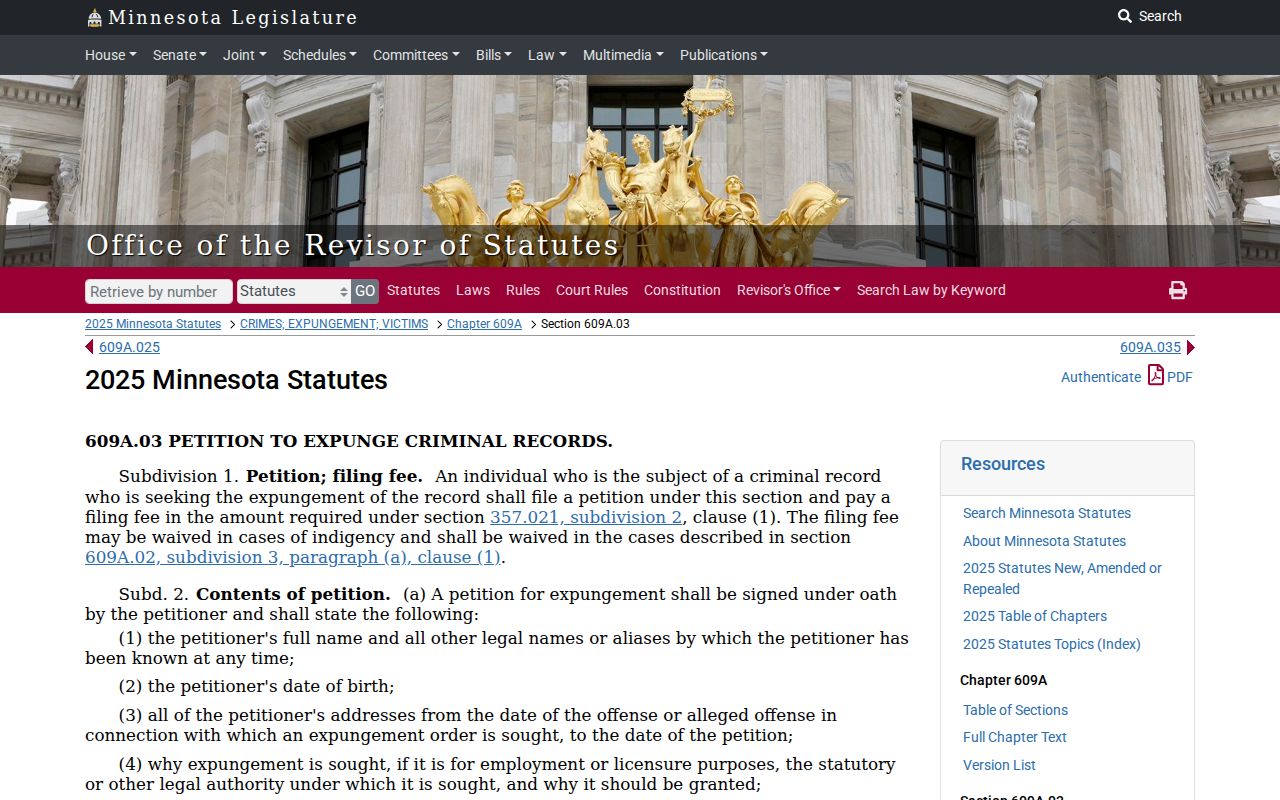
The statute determines notice and decision standards, while the case county supplies the filed order.
The Judicial Branch also publishes Minnesota expungement forms for the petition process:
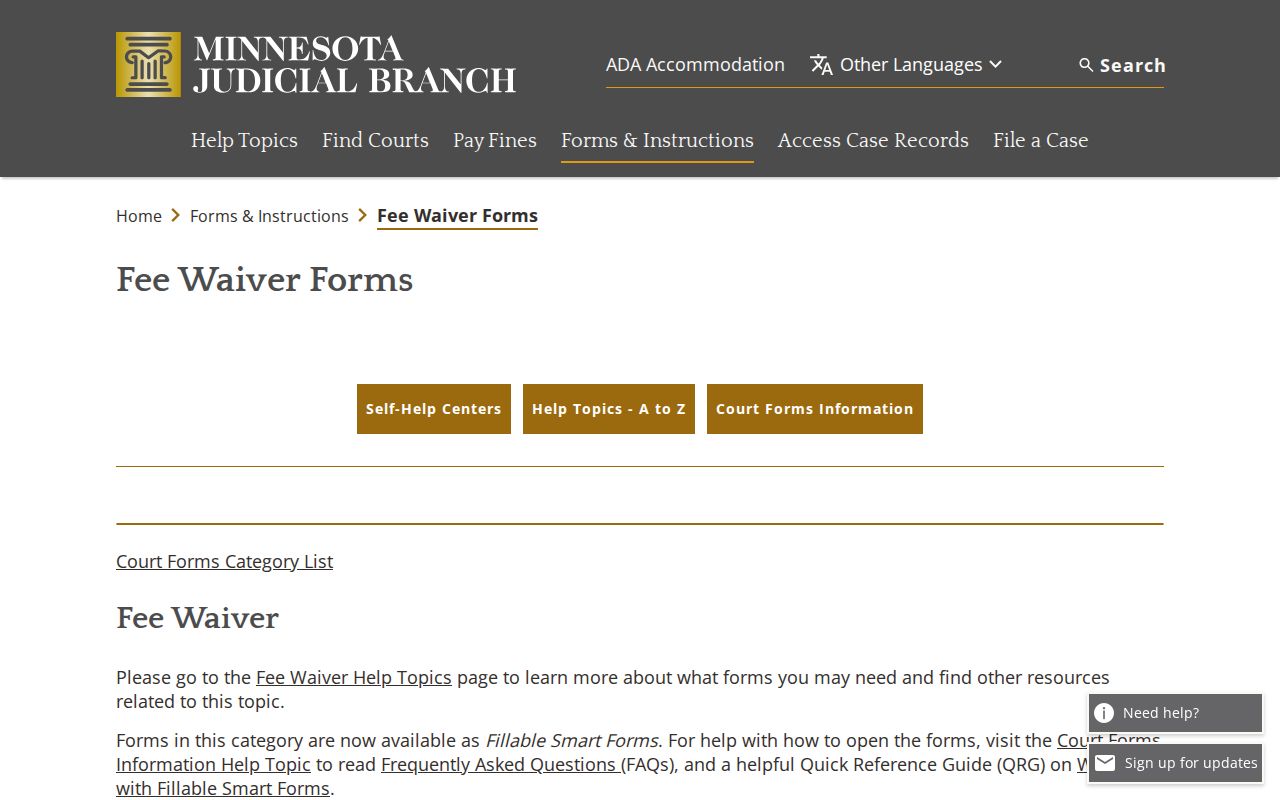
Use the current form set because eligibility, automatic sealing, and filing instructions can change.
Minnesota Criminal Record Access
Judicial case records chiefly follow the Minnesota Rules of Public Access to Records of the Judicial Branch. Sheriff, police, prosecutor, BCA, and DOC data instead fall under classifications in the Minnesota Government Data Practices Act. Sending a request to the wrong custodian can produce a referral because public court and executive data use different regimes.
Custodian check: Request the complaint, register, and disposition from Court Administration; booking from the sheriff; investigative data from the responsible agency; and compiled history from BCA.
Juvenile data is limited by section 260B.171, and juvenile criminal-history data is generally private under section 299C.095. Adoption, commitment and medical material, protected addresses, account numbers, juror data, and victim or minor information can also be withheld or redacted. Public at a courthouse does not always mean downloadable at home.
Get Minnesota Criminal Documents
Choose the county where the prosecution was filed. Save the exact case number, party name, document title, docket date, and desired copy type. Then use the directory of all 87 Minnesota counties to reach official District Court Administration. Ask whether the item is public, archived, remotely unavailable, or subject to party identification or a court order.
Specify plain, certified, or exemplified copies and whether all attachments are needed. Request the page count, certification charge, delivery options, and total before payment. If the court source is wrong, ask Court Administration about its correction process. If the court is right but the BCA entry differs, obtain the certified disposition and use BCA's challenge procedure. Data does not move between custodians at once.
Note: The filing county verifies and certifies the criminal case file even when a statewide portal first identifies the record.