
Active Minnesota Warrant Records
Minnesota judges issue arrest and search warrants through the court process, and District Court issues bench warrants in existing cases. Sheriffs and other law-enforcement agencies execute and maintain operational status. Minnesota's ordinary criminal, traffic, and ordinance matters sit in District Court because the state has no separate municipal or justice-court tier. The county printed on the citation or case caption identifies the local path.
No public search covers every county and warrant type. A sheriff may publish an online list, a PDF, an official mobile app, or no roster at all. MCRO can show a case event, but it is not definitive proof that the warrant remains active. Recall, quash, arrest elsewhere, bond, data-feed delay, and sealing can make a web result stale. Use the Minnesota county directory to reach both the issuing sheriff and District Court.
Law enforcement can use restricted state and national criminal-justice systems that the public cannot search. Electronic warrant processing does not create a public Minnesota master list. This difference is critical: the existence of a statewide operational system for officers does not give the public a statewide name-search channel. Public access remains tied to the issuing case and county agency.
Types of Minnesota Warrants
Warrant labels identify different legal processes. A court warrant, DOC release warrant, immigration detainer, another county's hold, and a bail condition are not interchangeable. A jail roster that displays a hold does not prove a public Minnesota bench warrant.
- Arrest warrant: authorizes arrest based on a complaint, probable cause, or another lawful process.
- Bench warrant: issues within a District Court case after failure to appear, violation, or noncompliance.
- Search warrant: authorizes a defined search; applications can remain sealed before execution and lawful release.
- Probation or release warrant: responds to an alleged supervision violation through court or DOC authority.
- Fugitive warrant: supports arrest and return across jurisdictions.
Search Minnesota Warrant Records
Collect the subject's full legal name, safe identifying details, possible county, case or warrant number, charge, and approximate issue date. Start with the county where the case, citation, or alleged violation arose. Many counties do not publish a complete list, so a no-result screen cannot close the inquiry.
Ask the official warrant unit or Court Administration whether it confirms status by phone and what identification it requires. Do not use false information or a friend as a proxy. Ask whether appearing in person can lead to arrest and consider counsel before making that visit.
A precise verification request is more useful than asking whether someone is “wanted.” Supply the case or warrant number, issuing county, full legal name, and approximate date. Ask whether the process is currently active, what type it is, whether bail is set, and which official office handles appearance. Staff may limit an answer for security reasons, and court staff cannot give legal advice.
- Select the likely county in the official routing directory.
- Check the sheriff's warrant page or list if one is published.
- Search MCRO by case or citation number and read current events.
- Call the issuing sheriff warrant unit or District Court using official contacts.
- Confirm number, type, issue date, charge, status, bail terms, and the office that handles appearance.
Minnesota Warrant Search Fields
County interfaces vary, so never promise one statewide form. Search with the most exact lawful identifier offered, then compare the issuing county and offense. The DOC fugitive page has its own narrower controls.
| Field Label | Type | Required | Notes |
|---|---|---|---|
| Last name | Text | Portal-specific | Use legal spelling and inspect common-name matches. |
| First name | Text | Usually optional | Narrows a common surname. |
| Date of birth or age | Date/number | Varies | May be absent or limited for safety. |
| Case or warrant number | Text | Alternative | Best link to the issuing record when known. |
Minnesota Warrant Record Fields
A public result can omit identifiers, address information, or operational detail. The issuing agency remains authoritative. Compare enough fields to avoid joining two people based only on a name.
Issue date does not establish present status. Likewise, a published bond amount does not show whether another hold exists, whether the bond type has changed, or whether the person can be released. If a case event says “warrant issued,” review later events for recall, quash, appearance, release, or disposition, then still confirm with the live agency source.
| Field | What It Shows |
|---|---|
| Warrant or case number | Identifier used by the sheriff and District Court. |
| Issue date and type | When the process issued and whether it is arrest, bench, search, or release-related. |
| Charge or reason | Alleged offense or violation, not proof of guilt. |
| Bail or bond | Published amount or type, subject to current confirmation and linked holds. |
| Issuing county and court | The offices that control the underlying case and warrant response. |
| Status | Current published label, which must be checked live with the issuing authority. |
Minnesota County Warrant Checks
Minnesota's 87 counties use their own sheriff practices. Search the likely issuing county, the county of arrest, and any county shown on a citation or prior case. For a city citation, locate the county District Court rather than looking for a separate municipal court. A county may confirm by phone, require an in-person process, or limit disclosure for safety.
A focused Chapter 13 request can seek public warrant fields from the sheriff. Name the subject, case or warrant number, date range, and exact existing data. Ask for segregable public portions and the statutory classification for anything withheld. Status should still be confirmed live because mailed or exported data can become stale.
When the likely county is unknown, trace the source event. A citation names a court location. A prior docket carries a county and case number. A supervision record can point to DOC rather than a new District Court bench warrant. A jail hold should be traced to the agency that placed it. Search each plausible county instead of treating one blank roster as statewide clearance.
Resolve a Minnesota Warrant
Confirm the exact county, case, type, charge, and current status. Ask whether the matter can be addressed by scheduling a hearing, filing a motion, paying an eligible fine, using an authorized calendar, or surrendering. Payment alone may not recall a warrant. Serious, unknown, or multi-county matters call for legal advice before action.
Confirm whether bail is preset, cash-only, bondable, or unavailable, plus accepted payment and any other holds. Arrange transportation, childcare, identification, and medication information. After appearance, retain the written recall, quash, or release order and verify the docket update. Clearing one warrant does not clear another county.
Important: Official instructions and counsel cannot guarantee immunity from arrest when a person calls, appears, or surrenders on a Minnesota warrant.
Minnesota DOC Active Fugitives
The Minnesota DOC Active Fugitives list covers supervised-release fugitives only. It is not a statewide arrest or bench-warrant roster. Its public inventory may show a name, DOC identifier or photo, and limited violation or last-known information. Tips about listed fugitives go to the DOC 24-hour line at 651-603-0026 or Crime Stoppers at 1-800-222-TIPS (8477). Those lines are not routine self-check services.
The official DOC fugitive search illustrates this limited state-level subset:
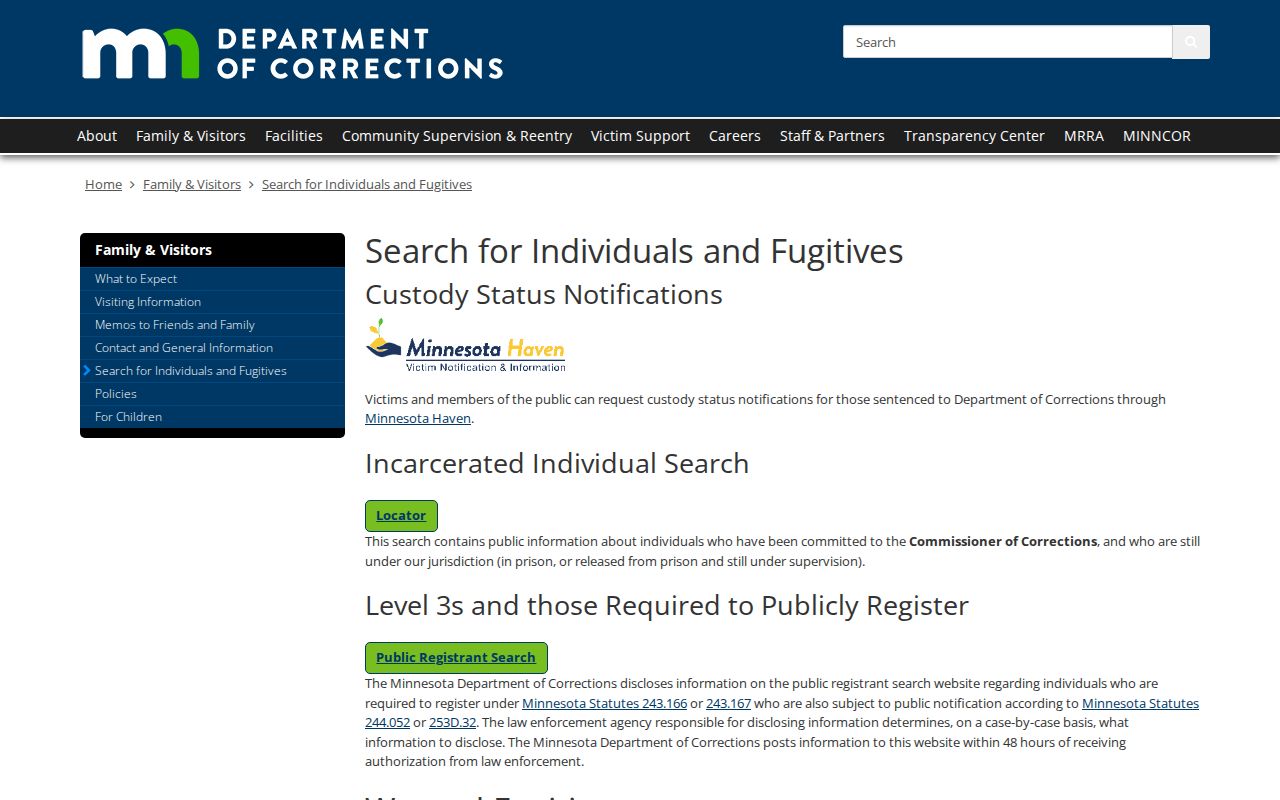
Return to the issuing county for ordinary court warrants, even when the DOC list produces no result.
Restricted Minnesota Warrant Records
Juvenile, sealed, quashed, sensitive, unexecuted search-warrant, and active-investigation material can be excluded or restricted. A public court event may say warrant issued while the application or current operational status remains unavailable. Absence from an online list can mean nonpublication rather than no warrant.
Federal warrants are separate. The U.S. Attorney's Office for the District of Minnesota prosecutes federal crimes, while the U.S. Marshals handles federal fugitives and prisoner operations. Neither system is an all-county Minnesota warrant search.
Search-warrant access also follows timing and court orders. An application, affidavit, or return can remain sealed before execution or for a longer lawful period. A public administrative file number does not guarantee that supporting material is downloadable. Juvenile matters and expunged cases require the narrow access route set by statute, rule, or order, not an adult public-name workaround.
The official Minnesota U.S. Attorney page marks the federal jurisdictional boundary:
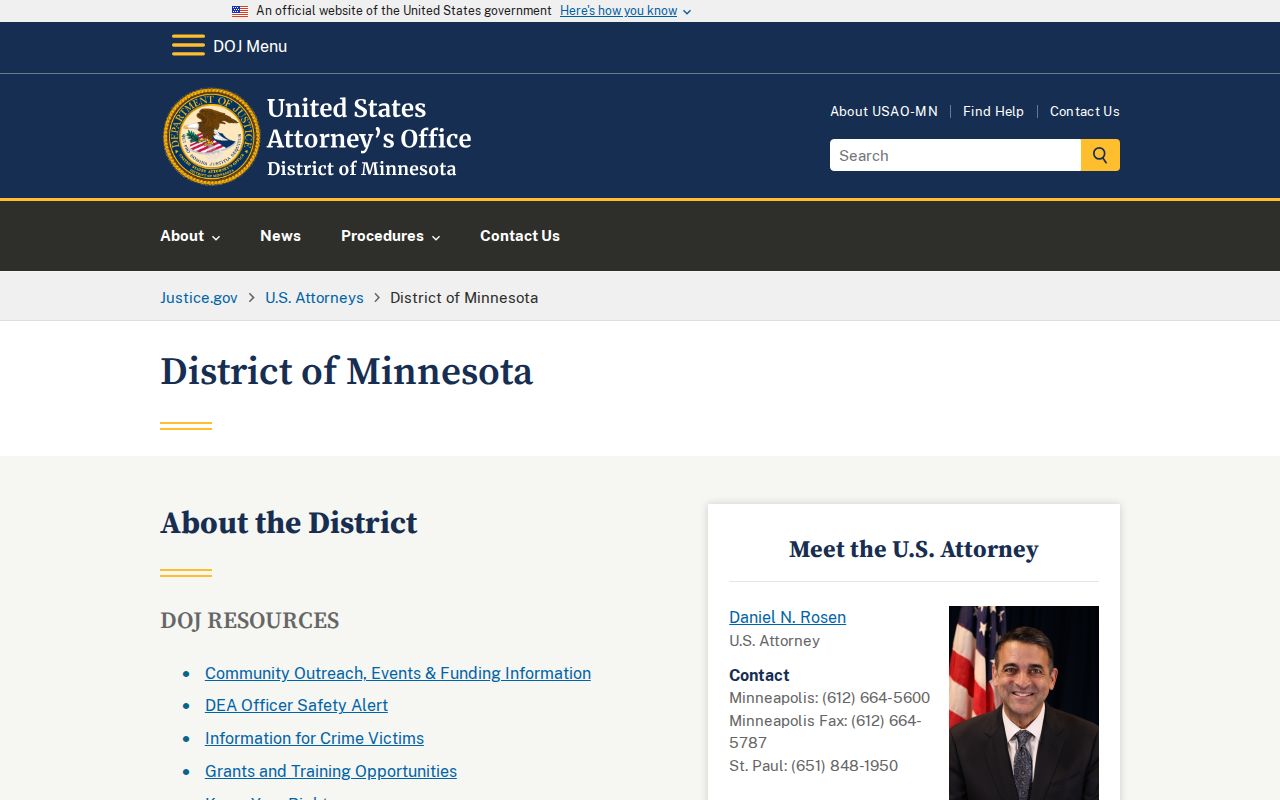
Use federal counsel and the responsible federal agency for a federal matter, not MCRO or a county roster.
If an official record appears wrong, identify the owner of the field. Court Administration handles its docket and warrant events. The sheriff handles its public roster or data response. DOC handles its fugitive status. Provide the exact identifier and supporting order to that custodian, then recheck other systems after processing because updates are not instantaneous.
For a certified underlying record, save the complete case number, county, event date, and document title from MCRO. Ask filing-county Court Administration whether the public warrant-related document is available, restricted, archived, or only viewable at a courthouse terminal. Specify plain or certified copy, attachments, delivery, and a cost estimate. Certification of the court event still does not replace live law-enforcement confirmation that the warrant remains executable.
Use emergency services only for an immediate danger, not for a routine record check. Anonymous tip lines are for information about listed or wanted people, not a promise of confidentiality for someone trying to determine personal warrant status. Counsel can review linked cases, contact the proper offices, and help plan an appearance without relying on a stale list.
Note: Record the date checked and obtain current confirmation before relying on any Minnesota warrant listing or docket event.