
Minnesota Court System Overview
Minnesota has a unified three-level judicial branch. The seven-justice Minnesota Supreme Court is the court of last resort. The 19-judge Minnesota Court of Appeals is one statewide intermediate court, and judges generally decide cases in three-judge panels. Minnesota District Court is the general-jurisdiction trial court in every one of the state's 87 counties. There is no separate high criminal court, county-court tier, justice-court tier, or statewide municipal-court tier.
District Court divisions organize the work. Criminal, civil, family, juvenile, probate, housing, and traffic cases remain District Court files. Conciliation Court is its small-claims division. The Minnesota Tax Court and Workers' Compensation Court of Appeals decide specialized disputes under their own authority, but they are not local trial-record repositories. This structure is vital when locating a record because a label such as Probate Division does not create a separate county clerk system.
Appeals path: Minnesota District Court › Minnesota Court of Appeals › Minnesota Supreme Court
| Court Level | Court Name | Jurisdiction / Case Types | Number in Minnesota |
|---|---|---|---|
| Court of Last Resort | Minnesota Supreme Court | Final state review, specified direct matters, attorney regulation, and branch supervision | 1 statewide court, 7 justices |
| Intermediate Appellate | Minnesota Court of Appeals | Appeals as of right from District Court and review of many agency decisions | 1 statewide court, 19 judges |
| General Trial Court | Minnesota District Court | Criminal, civil, family, juvenile, probate, housing, traffic, and conciliation matters | Locations in 87 counties |
| District Court Division | Conciliation Court | Simplified civil money claims, counterclaims, and statutory removal procedure | Within District Court |
| Specialized State Court | Minnesota Tax Court | Tax disputes assigned by statute | 1 statewide court |
| Specialized State Court | Workers' Compensation Court of Appeals | Workers' compensation benefit and liability appeals | 1 statewide court |
Note: Minnesota's unified trial level replaces the separate county and municipal tiers that exist in many other states.
Minnesota Supreme Court
The Minnesota Supreme Court provides final state review for both civil and criminal matters. It has seven justices and no separate criminal counterpart. Review of most Court of Appeals decisions is discretionary, which means a party petitions and the Supreme Court decides whether to accept the matter. The court automatically reviews first-degree murder convictions and legislative election contests, and it reviews specified Tax Court and Workers' Compensation Court of Appeals matters. It also regulates lawyers and supervises the Judicial Branch.
A Supreme Court appeal usually concerns the existing record and legal issues rather than new testimony. Its opinions bind lower Minnesota courts. If a federal constitutional or statutory question remains after the final state decision, further review may be sought in the U.S. Supreme Court under federal rules. Public appellate records belong in P-MACS, while the District Court trial record remains with the filing county and its statewide trial systems.
Minnesota Court of Appeals
The Minnesota Court of Appeals is a single statewide court, not ten geographic appellate courts. Its 19 judges generally sit in three-judge panels. Nearly every appeal from Minnesota District Court goes there as of right, along with selected appeals from administrative agencies. The court examines the trial record, briefing, and legal claims. A party who seeks further state review files a petition with the Minnesota Supreme Court.
The distinction between the Court of Appeals and Minnesota's ten judicial districts prevents a common records error. The numbered districts group District Court locations for trial administration. They do not define the appellate court's territory. An appeal creates a new statewide appellate case number and docket in P-MACS, while MCRO retains the trial-level register and notice-of-appeal events.
| Structure | Scope | Record System |
|---|---|---|
| One Minnesota Court of Appeals | Statewide intermediate appellate jurisdiction | P-MACS public appellate search |
| Three-judge panels | Review of District Court and selected agency decisions | Briefs, motions, orders, opinions, and events where public |
| Ten judicial districts | Trial administration only, not appellate geography | MCRO and local District Court Administration |
Minnesota District Court Jurisdiction
Minnesota District Court is the state's general-jurisdiction trial court and the only ordinary trial tier. It hears felonies, gross misdemeanors, misdemeanors, criminal traffic, civil claims, divorce, custody, support, juvenile, probate, eviction, and ordinance cases. Conciliation matters also remain within District Court. A city traffic case prosecuted in court is not sent to a separate Minnesota municipal court. City parking and other administrative citations can follow a noncourt process, so the citation itself must be checked.
A District Court location exists in every county. The ten judicial districts assign judges and organize administration. Rural counties may share chambered judges, but that arrangement does not merge files. Venue, the caption, and the case location identify the record office. If the docket shows a transfer or change of venue, the original and receiving court offices may need to clarify which holds an exhibit or certified final record. Use the county directory to reach the proper District Court Administration.
The official Minnesota Judicial Branch explains how Conciliation Court operates within the trial system.
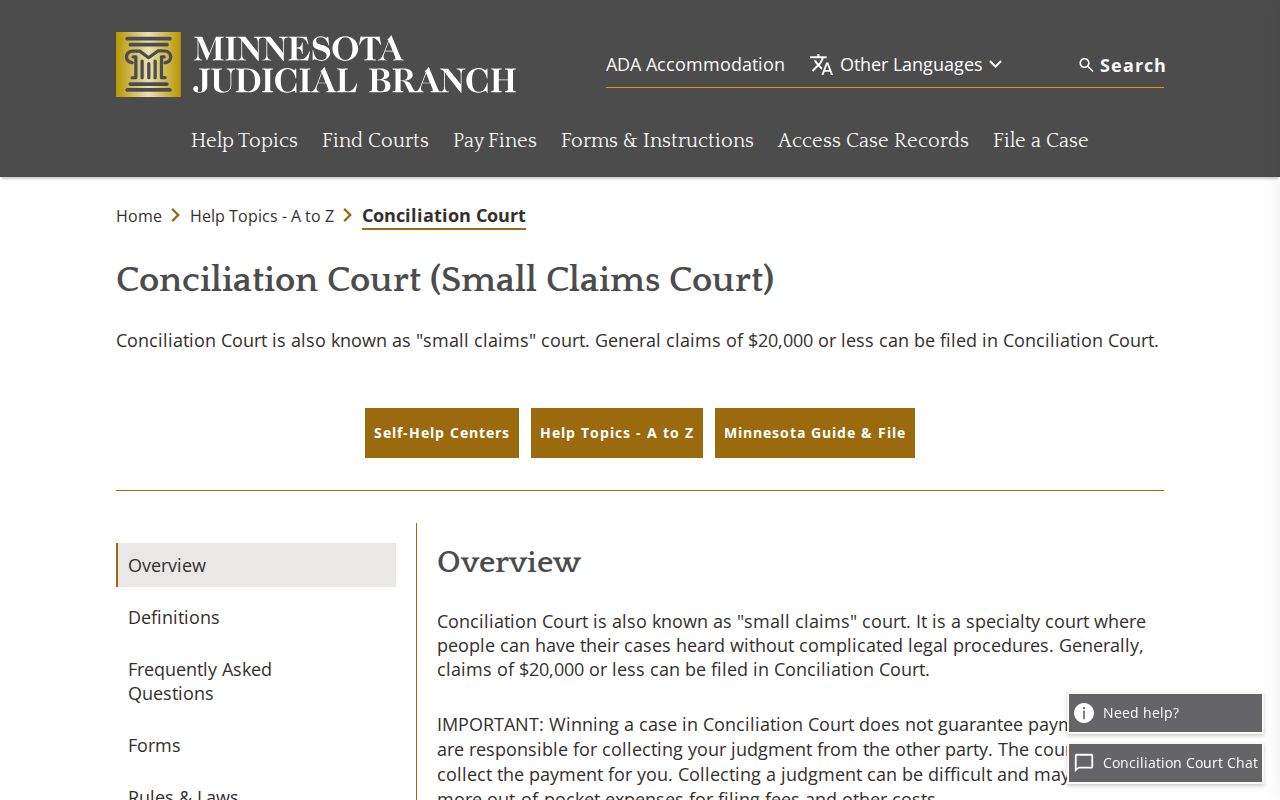
Its simplified process does not remove the case from District Court, and its judgment remains a court record subject to removal and review rules.
Note: A shared judge or specialized calendar does not change which filing county maintains and certifies the trial record.
Minnesota Court Level Comparison
Jurisdiction in Minnesota turns more on trial versus appellate function than on competing local court levels. District Court finds facts, receives evidence, and enters the original judgment or sentence. The Court of Appeals reviews claimed error in the existing record. The Supreme Court chooses most of its docket and resolves final statewide questions. Special courts address narrow subjects assigned by law.
| Court | Primary Work | Record Route |
|---|---|---|
| Minnesota Supreme Court | Final state review, mandatory categories, governance | P-MACS and Clerk of Appellate Courts |
| Minnesota Court of Appeals | Appeals as of right and selected agency review | P-MACS and Clerk of Appellate Courts |
| Minnesota District Court | All ordinary trial case types and local divisions | MCRO, MNPAC, and filing-county Court Administration |
| Minnesota Tax Court | Tax disputes assigned by statute | Special court's official procedures |
| Workers' Compensation Court of Appeals | Workers' compensation appeals | Special court's official procedures |
Appeals Through Minnesota Courts
A Minnesota case starts with a complaint, petition, application, or citation in District Court. Service or a criminal first appearance follows. Scheduling, motions, settlement or plea, trial, judgment or sentence, and posttrial motions build the trial record. A notice of appeal normally starts review in the Court of Appeals. That court does not retry the witnesses. A party then may petition the Supreme Court, which generally selects whether to grant further review.
Criminal path: Complaint or indictment › First appearance › Pretrial proceedings › Plea or trial › Disposition and sentence › Minnesota Court of Appeals › Petition to Minnesota Supreme Court
Civil path: Complaint or petition › Service and answer › Motions and discovery › Settlement or trial › Judgment › Minnesota Court of Appeals › Petition to Minnesota Supreme Court
Conciliation path: Claim › Hearing › Order for judgment › Statutory removal or trial de novo procedure in District Court
Note: An appeal creates a second case and docket; the appellate file does not replace the District Court evidence record.
Minnesota District Court Divisions
Civil, Criminal, Family, Juvenile, Probate, and Housing labels organize Minnesota District Court work. Family calendars hear divorce, custody, support, paternity, and domestic-abuse matters. Probate covers estates, wills, guardianship, and conservatorship. Juvenile and adoption files have special access limits. Housing Court is specialized in Hennepin and Ramsey, while eviction matters elsewhere remain ordinary District Court cases. Treatment courts address substance use, DWI, veterans, mental health, and related needs as District Court programs.
Special management does not change the custodian. Court Administration maintains the official file in the filing county. A program's statewide standards also do not guarantee that every county offers the same calendar or eligibility. Records remain subject to the case type's access rules, including tighter control over adoption, juvenile, medical, confidential-address, and protected-person material.
Minnesota Specialty Courts
Minnesota does not have a separate modern county, justice, or municipal court tier for ordinary cases. Older local functions were consolidated into District Court. The Minnesota Tax Court and Workers' Compensation Court of Appeals are specialized statewide bodies, not lower county courts. Their review paths depend on governing law and may reach the Minnesota Supreme Court. They do not maintain ordinary criminal, family, probate, or traffic files.
That absence matters for searches. A person should not look for a generic municipal clerk after receiving a court citation. The notice should identify either a Minnesota District Court location or a city administrative process. Conciliation Court is also not a separate constitutional court. It remains the simplified small-claims division of District Court.
Federal Courts in Minnesota
Federal courts form a separate hierarchy. The U.S. District Court for the District of Minnesota is one federal district covering the state. It hears federal criminal prosecutions, civil-rights and constitutional claims, federal statutory matters, diversity cases meeting federal requirements, and other cases within federal jurisdiction. Its records do not appear in MCRO.
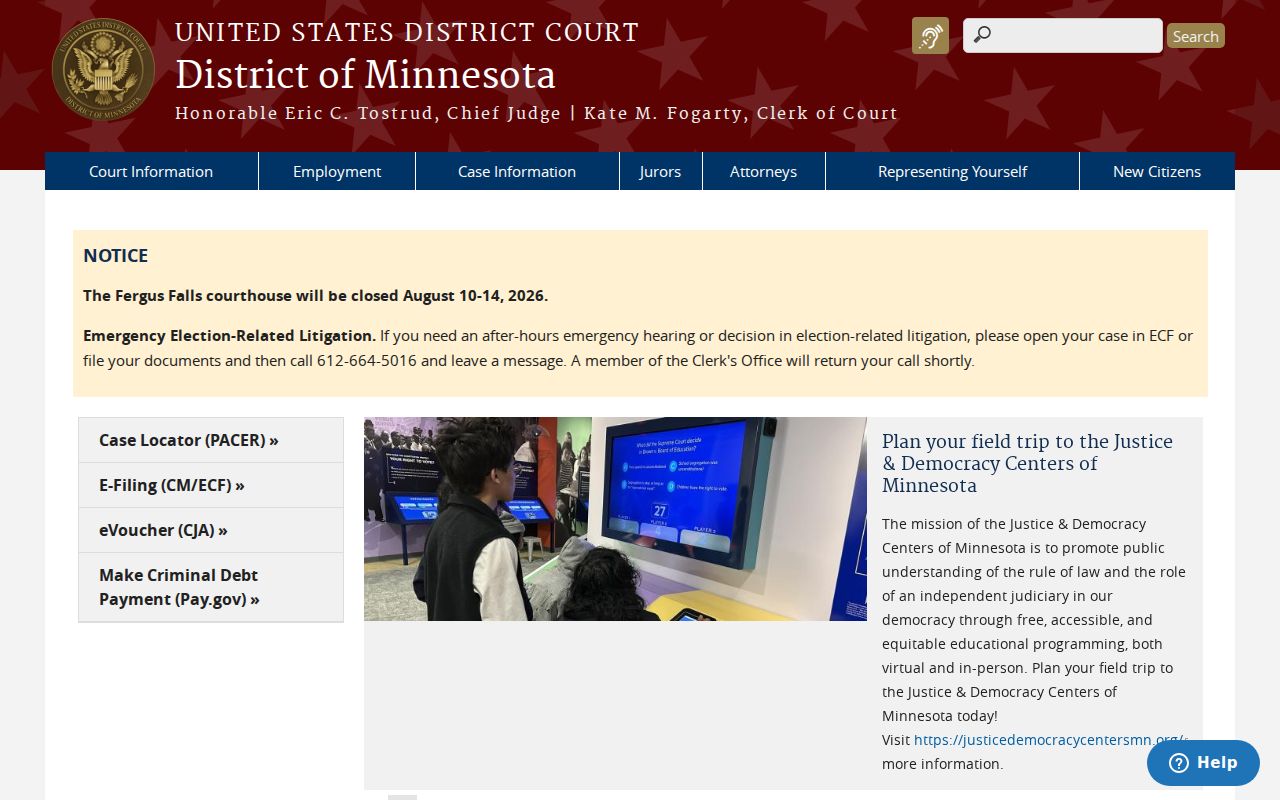
Federal trial dockets use PACER, and certified records must come from the federal clerk rather than Minnesota District Court Administration.
Minnesota Federal Bankruptcy Court
The U.S. Bankruptcy Court for the District of Minnesota handles bankruptcy petitions, schedules, claims, trustee events, discharge or dismissal, and adversary proceedings statewide.
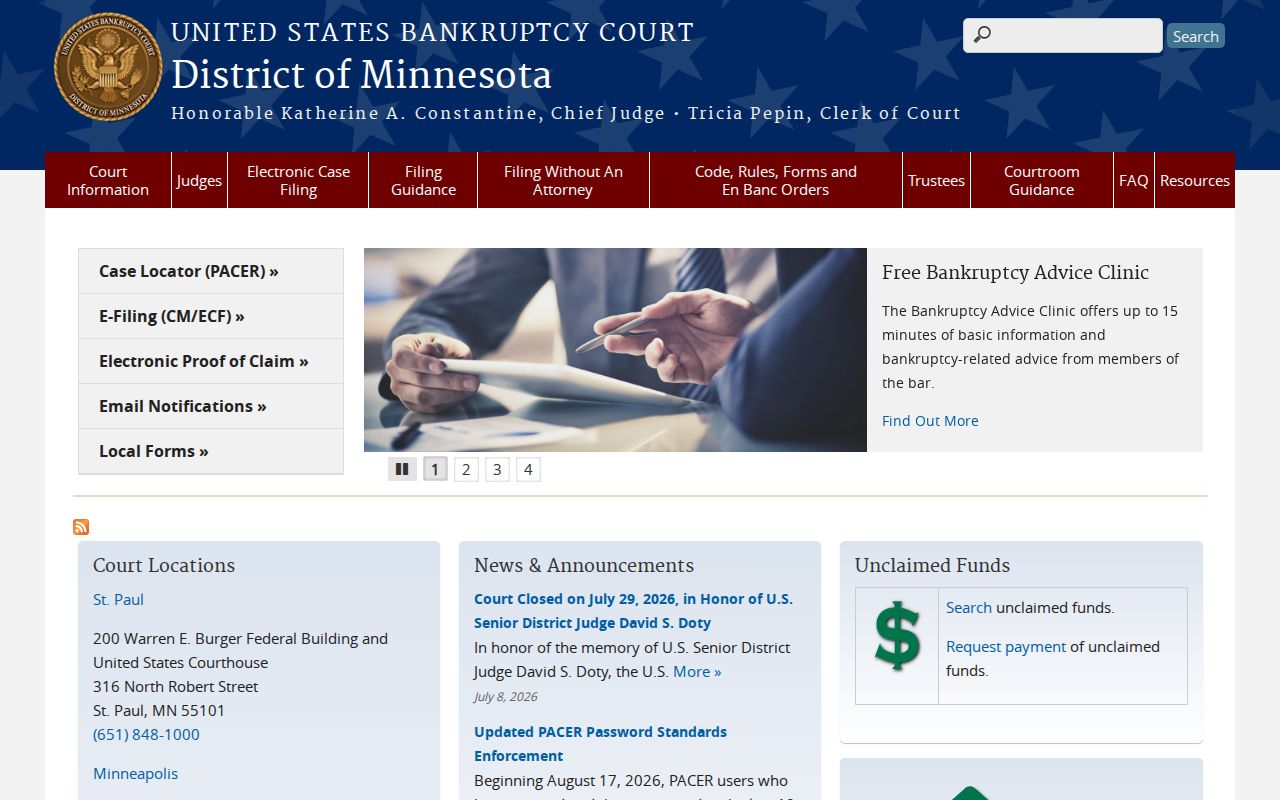
Bankruptcy papers can contain redacted sensitive identifiers, and formal copies come from that court's clerk.
Minnesota Federal Appeals
Federal appeals from Minnesota proceed to the U.S. Court of Appeals for the Eighth Circuit.
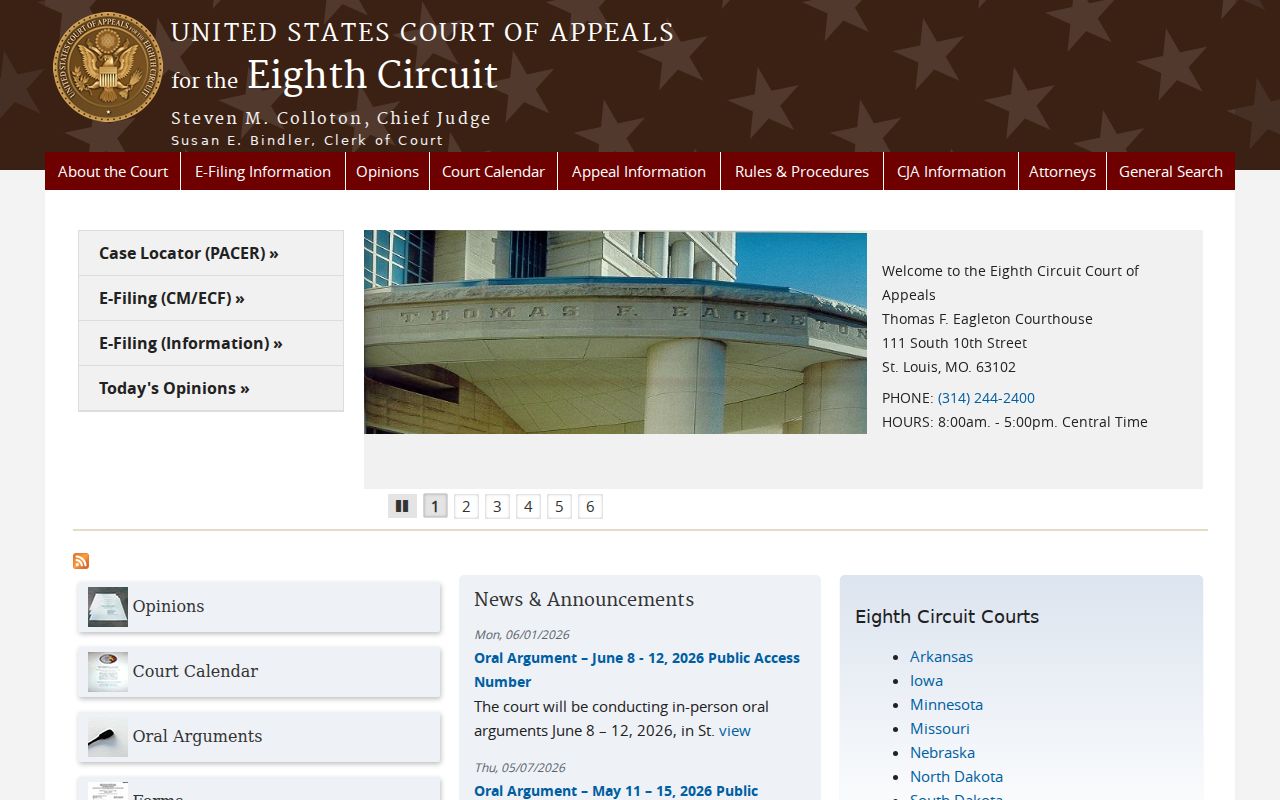
A further petition may reach the U.S. Supreme Court. None of these federal dockets is reliably included in Minnesota MCRO or P-MACS.
Note: Minnesota state court staff cannot certify a federal filing, even when the events arose within the same county.
Minnesota Court System History
Minnesota's Constitution established judicial power and the Supreme Court at statehood in 1858. Later constitutional and statutory changes produced a unified, state-funded branch. District Court became the single general trial level, and the old municipal, probate, county, and justice-court functions were consolidated. That history explains why a modern Minnesota search should not invent a separate county or municipal court for ordinary cases.
The Minnesota Court of Appeals began in 1983 to manage rising appellate volume and provide review as of right. Court technology later moved from paper-centered files to eCourtMN. Statewide mandatory eFiling and eService for required filers reached all counties in 2016. MCRO then released Document Search in 2021, Case Search later that year, and Hearing and Judgment Search in 2022. Remote access remains deliberately narrower than courthouse MNPAC and local archive access.
Note: Court modernization expanded access, but it did not transfer local paper, exhibits, or certification away from the filing county.
Find Minnesota District Courts
Trial records remain tied to the county where the case was filed. Browse the directory of all 87 Minnesota counties to reach the correct District Court location and Court Administration office. MCRO offers a broad statewide starting point, but the filing office controls local paper, exhibits, archived volumes, certification, and case-specific correction. If venue changed, ask which location now holds the requested item.
Appellate records use P-MACS and the Clerk of Appellate Courts. Federal cases use PACER and the responsible federal clerk. Choosing the right level before making a request prevents a state office from receiving a federal request, an appellate clerk from receiving a trial-file request, or a county government recorder from receiving a Judicial Branch court-record request.