
Minnesota Court Docket Basics
Minnesota calls the chronological docket the register of actions. It records when a complaint, petition, citation, affidavit, motion, notice, order, judgment, sentence, or satisfaction entered the case. Each entry normally shows an event date and event label. Some entries link to a public PDF. Others do not. The absence of a link does not prove that the paper is confidential. It can mean the paper is old, physical, restricted from remote access, or simply not available as a downloadable document.
Minnesota has one ordinary trial-court tier, the Minnesota District Court. It handles civil, criminal, family, juvenile, probate, traffic, housing, and conciliation matters through case divisions and calendars. There is no separate statewide county-court, justice-court, or municipal-court tier. A city ordinance case prosecuted in court therefore enters the District Court framework. Administrative parking matters may remain with the city, so the issuing notice controls. The filing county's District Court Administration maintains the trial docket and supplies certified copies.
A docket is an index and procedural history, not the complete evidence file. Exhibits can be physical, returned, destroyed under schedule, or separately restricted. Transcripts require the reporter or transcription process. A public event can coexist with a nonpublic attachment. Read the exact entry first, then request the named document by title and date.
Search Minnesota Court Dockets Online
Minnesota Court Records Online (MCRO) provides many public District Court case details and documents for court locations in all 87 counties. Case Search is the main route to the register of actions. Hearing Search focuses on schedule information. Judgment Search covers qualifying public docketed money judgments. Document Search helps when the case number and filing are known. MCRO is free and currently requires no registration, but it does not contain every public record or older paper.
- Choose Case Search and enter the full case number without spaces. Preserve its hyphens and leading zeroes.
- If the number is unknown, search exact party names statewide, then try middle-name variations, wildcard, or Sounds Like.
- Confirm the court location, case category, parties, and filing date before opening the register of actions.
- Read docket entries chronologically and note the exact title and date of any document needed.
- Use MNPAC at a courthouse or contact filing-county Court Administration when remote detail is missing.
The official MCRO interface shows the statewide public docket entry point.
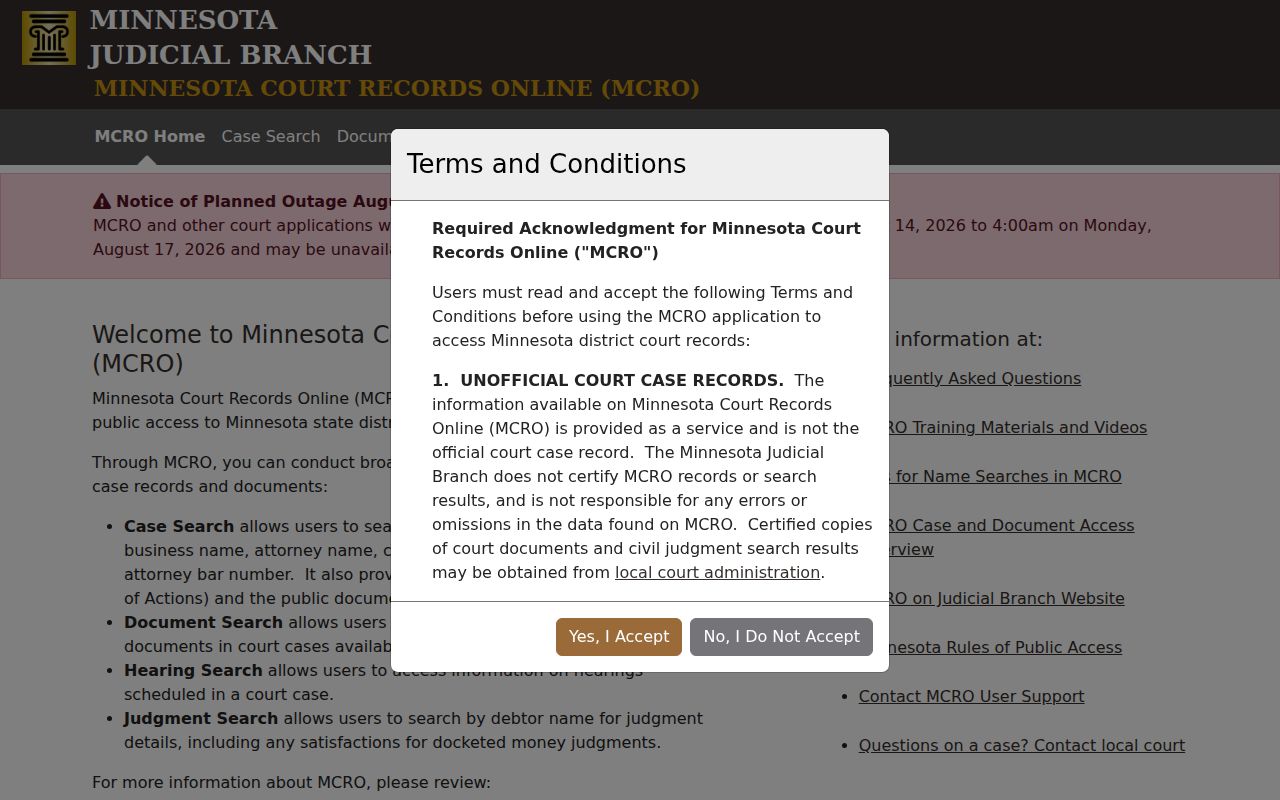
Its search tabs answer different questions, so a hearing search should not be treated as a full case history or final result.
Note: Recent filings and schedule changes can lag online, so confirm a time-sensitive event with the filing court.
Read Minnesota Court Docket Entries
A Minnesota register of actions should be read as a timeline. The court filing date starts the official case file, but it may follow the incident, citation, arrest, separation, or document-signing date. A judge may sign an order before the clerk enters it. Appeal periods can turn on entry or service rules. A continuation changes the next event without deciding the dispute. The last line is important, but it may show later enforcement or reopening rather than the original disposition.
| Field | What It Shows |
|---|---|
| Entry date | When the filing or event was added to the register, which can differ from its signed or incident date. |
| Event type | The court's label for a complaint, service, hearing, motion, order, judgment, sentence, appeal, or other event. |
| Filing party | The plaintiff, defendant, petitioner, respondent, prosecutor, or other filer where shown. |
| Document link | A remotely accessible public PDF; no link can mean limited remote availability rather than confidentiality. |
| Hearing details | Date, time, type, court location or remote designation, and judicial officer where public. |
| Disposition | The result of a claim, charge, or case, which must be checked count by count when more than one exists. |
| Judgment data | Creditor, debtor, docketing, satisfaction, or related money-judgment events for qualifying files. |
Common event families help organize a long Minnesota court docket. Initiation includes a complaint, petition, application, or citation. Process includes summons and service. Scheduling includes notices, hearings, trials, and continuances. Adjudication includes findings, orders, verdicts, judgments, decrees, pleas, and sentences. Enforcement can add writs, garnishments, warrants, contempt, or satisfaction. An appeal can add notices and transcript activity to the trial docket while creating a second appellate case.
Minnesota Court Docket Systems
Trial and appellate Minnesota court dockets use different official systems. MCRO and courthouse MNPAC access District Court data. The P-MACS public appellate search covers the Minnesota Supreme Court and the one statewide Minnesota Court of Appeals. An appeal receives a second case number. P-MACS can show motions, briefing, oral argument or submission, orders, opinions, counsel, petition activity, and event history. MCRO may show that a notice of appeal was filed, but it does not replace the appellate docket.
- District Court: MCRO for many public remote details and documents across Minnesota.
- Courthouse access: MNPAC for a fuller statewide electronic public view, plus the filing counter for local paper.
- State appeals: P-MACS for Supreme Court and Court of Appeals dockets, with certification from the Clerk of Appellate Courts.
- Federal cases: PACER and the relevant federal clerk, not MCRO or P-MACS.
The public Minnesota appellate case search makes the distinct second docket visible.
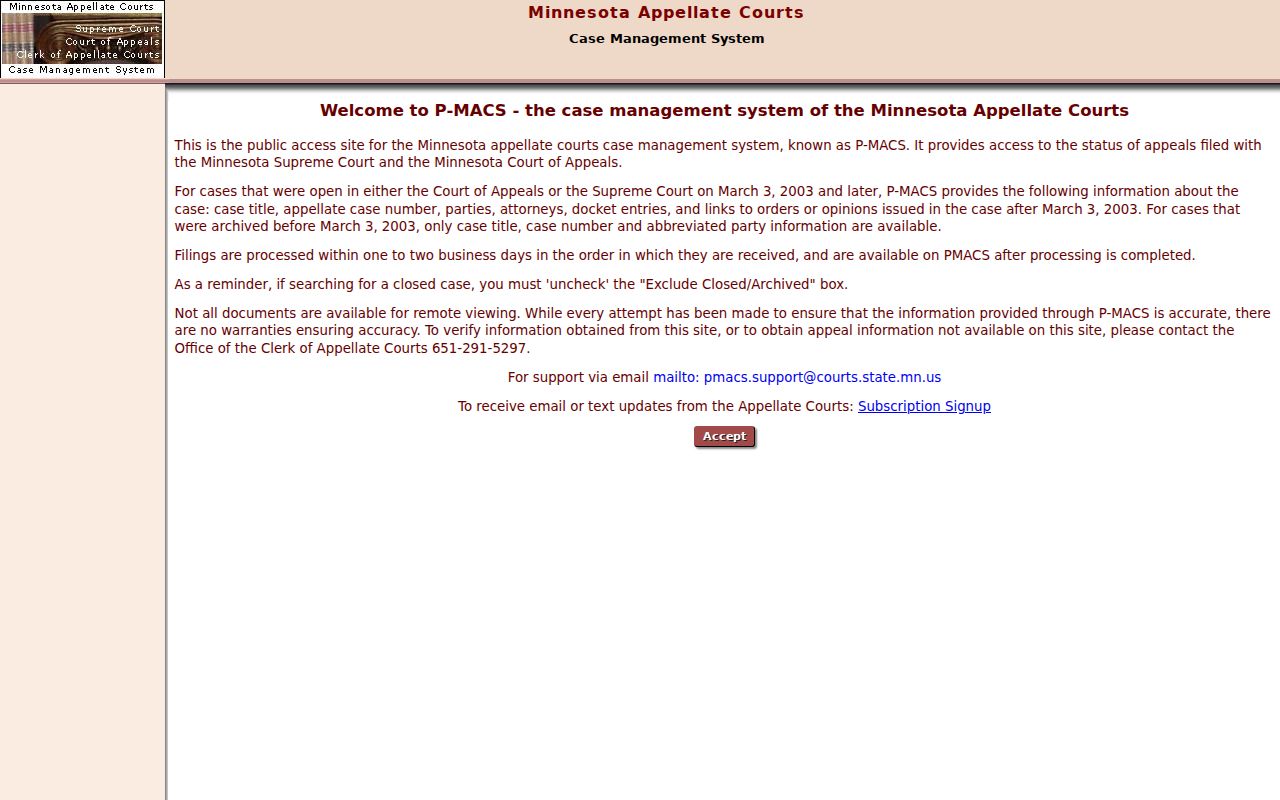
The ten numbered Minnesota judicial districts organize trial administration. They are not appellate districts, and the Court of Appeals is statewide.
Note: Search both the trial and appellate case numbers when later review may have changed or affirmed the result.
Docket vs. Full Case Record
The Minnesota court docket provides orientation and sequence. The full case record supplies the filed text, evidence, and formal order. Both belong to the court record, but they can have different access conditions. An online docket may be free while a paper exhibit requires retrieval, a copy charge, and separate review. A certified register confirms the clerk's record of events. A certified order confirms a specific filed document. Neither automatically answers a statewide background-check question.
| Docket | Full Case Record | |
|---|---|---|
| Format | Chronological register of events | Filed complaints, motions, exhibits, orders, and other papers |
| Remote access | Often available in MCRO or P-MACS | Only selected public PDFs are remotely accessible |
| Best use | Track progress and identify key dates | Read allegations, arguments, evidence, and exact court rulings |
| Formal proof | Certified register from the proper clerk | Certified copy of the named document |
| Missing item | Check MNPAC or proper appellate system | Ask the filing court about paper, archive, exhibit, or restriction |
A current judgment payoff must come from Court Administration because interest and payment events can change after the online entry. Likewise, a hearing listing can change after a continuance. Confirm date, location, and access instructions shortly before attendance. A remote label on the docket is not permission to join or record a proceeding.
Interpret Minnesota Court Docket Terms
A register of actions can use short labels, but the filed order controls. A complaint begins a civil action or states criminal charges. A motion asks the judge for an order. A continuance moves a hearing or deadline. Disposition describes how a count, claim, or case ended. Judgment is the enforceable adjudication. Satisfaction of judgment records payment or resolution of a judgment. Dismissed with prejudice ordinarily bars refiling of that claim, while dismissed without prejudice can permit a legally timely new filing.
Pending, closed, inactive, stayed, transferred, reopened, and disposed describe procedure, not a single universal outcome. A closed criminal case can contain both dismissed and convicted counts. A probation violation may cause later entries. A civil file can close while its money judgment remains unsatisfied. A probate file can reopen when another asset appears. Review each disposition and later enforcement event instead of treating the case-status badge as the full answer.
Identity also requires care. Compare middle name, county, case type, event dates, attorney, and any other public distinguishing field. A shared name does not join separate people. For a recent pending criminal matter, defendant-name search is blocked remotely until a qualifying conviction. Use the case number, citation number, attorney name, or bar number, or contact the filing court. That restriction should never be converted into a claim that no pending case exists.
Note: The exact docket wording and filed order control; a short event label should not be expanded into an unsupported legal conclusion.
Federal Dockets Outside Minnesota MCRO
Minnesota is one federal judicial district, but federal matters are separate from state court dockets. The PACER system supplies federal District Court, Bankruptcy Court, and appellate docket access. Registration and current federal fees apply, while opinions are free under PACER rules. Certified federal documents come from the federal clerk. State District Court Administration cannot certify them.
The official PACER source illustrates the separate federal access path.
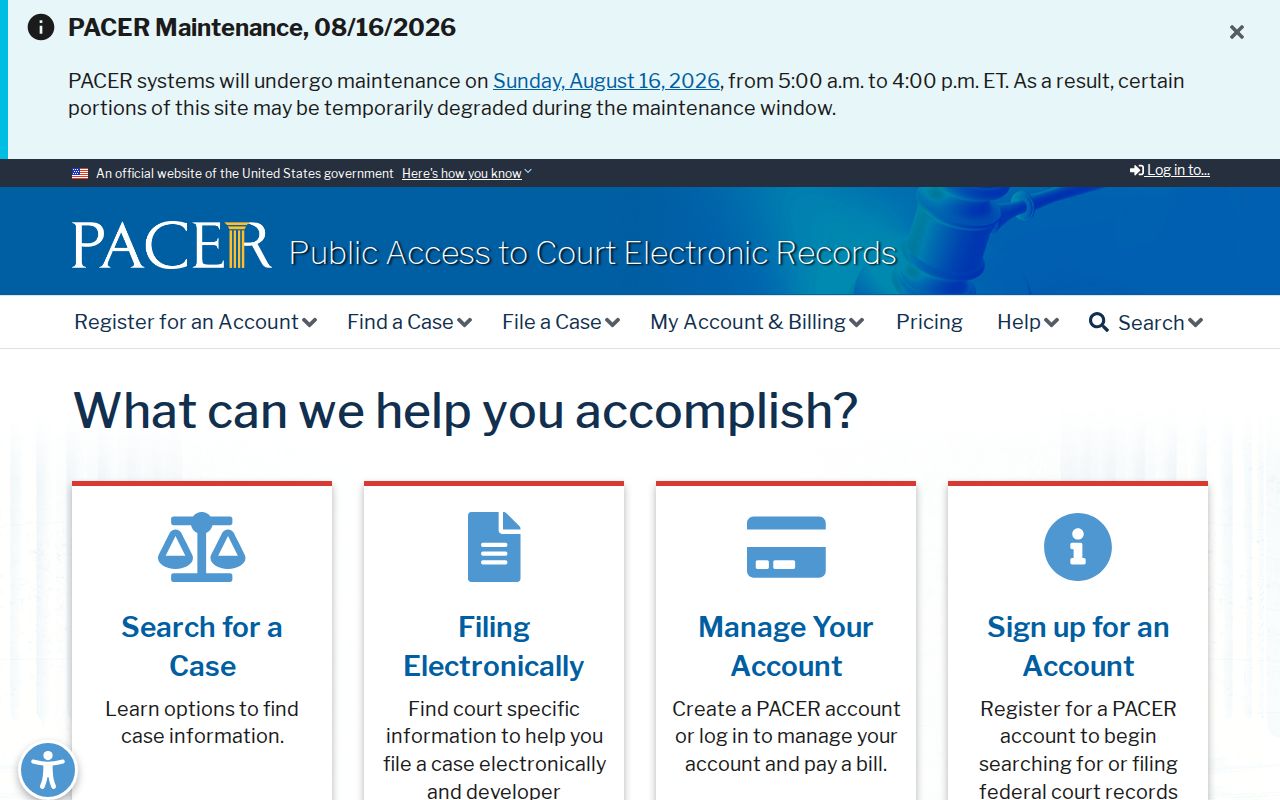
Older federal paper may require an archive route identified by the federal clerk. Start with the case number and court so the clerk can locate any accession information.
Note: A federal name match belongs to a separate jurisdiction and should not be merged with a Minnesota state case.
Get Certified Minnesota Court Dockets
Choose the filing county in the Minnesota county directory, then ask District Court Administration for a certified register of actions. Provide the complete case number, party names, approximate year, and desired copy type. If only certain filings are needed, give their exact docket titles and dates. Ask whether the file is public, electronic, archived, or subject to party identification or a court order. Request a page count, certification charge, delivery method, and total before sending payment.
Courthouse MNPAC can help locate the right event before a paid request. Mail requests may use the statewide copy form or a clear written request accepted by that court. Local email, secure delivery, payment, and archive practices vary. For an appellate docket, contact the Clerk of Appellate Courts after locating the second case in P-MACS. Record the date checked, because later orders, continuances, satisfaction, or appeal activity can change the docket.