
Minnesota District Court Probate
The Probate Division of Minnesota District Court handles testate estates with a will, intestate estates without one, formal and informal probate, appointments of personal representatives, supervised administration when ordered, and trusts brought before the court. District Court also handles guardianship and conservatorship. A registrar can review a qualifying uncontested informal application. Contested wills, uncertain heirs, supervised cases, and other requested judicial findings use formal proceedings.
Probate is a case type within Minnesota's general trial court, not an independent courthouse system. The file remains associated with the county where the case was brought. Court Administration provides certified documents and locally stored paper. Use the Minnesota county directory to reach the correct office after the statewide search identifies venue.
Whether probate is needed depends on how property is titled and transferred. Solely owned assets may require a court appointment. A beneficiary designation, joint ownership, or trust can move property outside probate. Minnesota's small-estate affidavit may provide another route when its current statutory asset and timing conditions are met. Real estate, a business, unknown heirs, taxes, disputed creditors, or a contested will can make formal advice important. A court file should not be opened or skipped based only on estate size.
Once appointed, a Minnesota personal representative must follow the applicable notice and administration duties. The work can include securing property, locating heirs and devisees, notifying creditors, addressing taxes and family allowances, valuing assets, resolving claims, seeking court orders, distributing property, and filing the proper closing document. A bond may apply. The register of actions records filed steps, but not every act of day-to-day administration becomes a public court document.
Minnesota Probate Terms Defined
Minnesota estate and protected-person files use terms that identify authority, procedure, and the kind of property or decision at issue. The court appointment matters. A will naming an executor does not by itself authorize that person to transact for the estate.
- Testator
- The person who made a will.
- Personal representative
- The person appointed by District Court to administer the estate; a will may nominate that person.
- Intestate
- Dying without a valid will, leaving distribution to Minnesota intestacy law.
- Letters
- Court-issued proof of a personal representative's current authority.
- Guardianship
- Court authority focused on personal care and decisions for a protected person.
- Conservatorship
- Court authority focused on managing a protected person's financial estate.
- Inventory
- A required asset listing whose sensitive financial details may be restricted.
Institutions may require recently certified Letters rather than an online order or an old copy. Ask Minnesota Court Administration whether the appointment remains active and which certified product it can issue.
Search Minnesota Probate Records
Minnesota Court Records Online provides statewide access to many public District Court probate cases and documents. Search a decedent's or protected person's name and narrow by county, probable year, or PR case classification. A Minnesota case number identifies the court location, filing year, and sequence. MCRO is not complete for every older file, restricted item, or remotely unavailable document. A free MNPAC courthouse terminal can show more public electronic data, and P-MACS holds a separate appellate file when a probate order is appealed.
- Identify the decedent's Minnesota county of domicile and probable death or filing year.
- Search MCRO by name and PR category, then save the complete case number and court location.
- Review appointment, Letters, notices, available inventory or accounts, case status, and closing events.
- Contact county Probate Court Administration for the exact will, order, Letters, or other named document.
- Ask whether the item is public, archived, certified, current, or subject to restricted-party access.
A public case status can mislead when read alone. An estate may be administratively closed and later reopened for a discovered asset. A filed will does not prove distribution is finished. Current certified Letters, not the will alone, commonly serve as proof that the appointment remains active.
Search failures have several Minnesota-specific explanations. The name may differ from the filed form, the case may predate electronic coverage, the packet may be archived, or access may be restricted. Search a reasonable year range and name variant, then call the likely county. If no probate opened, check nonprobate transfer possibilities instead of assuming that assets or a will never existed.
Minnesota Probate Court Locations
Each Minnesota county has a District Court location, and probate work sits within that unified court structure. The ten judicial districts are trial-court administrative groupings, not separate probate or appellate systems. Local Court Administration gives phone guidance, retrieves paper or archived records, accepts locally permitted mail or in-person copy requests, responds under Judicial Branch public-access rules, and certifies court documents. Courthouse hours, payment, delivery, and archive location can differ.
Find Minnesota Probate Court Administration: Browse the directory of all 87 Minnesota counties to reach the filing county's official court record route.
MCRO can orient the search from anywhere in Minnesota, but the filing county remains responsible for its local archive and certification. Call before traveling when the requested estate packet is old or stored offsite.
Minnesota Probate Record Fees
Minn. Stat. §357.021 supplies the court-fee authority, but the exact Minnesota probate filing total depends on the case posture and county law-library or other authorized surcharges. Plain copies follow page or local branch schedules. Certified or exemplified documents add certification or authentication. An eligible litigant may seek a fee waiver, but a waiver does not automatically erase every service, transcript, vendor, or delivery charge.
| Item | Amount |
|---|---|
| Probate, guardianship, or conservatorship filing | Statutory and local components; obtain county total |
| Plain court copy | Per-page or local branch schedule |
| Certified Letters, will, or order | Copy plus certification charge |
| Archive retrieval or delivery | Quoted when applicable |
| Fee waiver | Available by application and judicial review when qualified |
Ask for an itemized Minnesota total before filing or ordering a long packet. Page count, certification, retrieval, local surcharge, and delivery may affect the charge, while free MCRO access does not create a certified copy.
Minnesota Probate Record Contents
A Minnesota estate file may show the decedent's name, county, PR case number, opening date, status, applicant or petitioner, public heirs or interested-person roles, will and codicils, application or petition, acceptance, appointment, Letters, creditor notice, publication, claims, objections, hearings, orders, accounts, and closing statement or decree. Some documents may be public but unavailable as remote PDFs. Court Administration controls the official and certified copy.
| Probate Field or Item | Minnesota Record Meaning |
|---|---|
| County and PR case number | Identifies the District Court custodian and estate file. |
| Opening date and status | Shows case timing, but closure may not prevent later reopening. |
| Applicant, petitioner, heirs, interested persons | Shows public party roles where accessible. |
| Will, petition, acceptance, and Letters | Opening papers and evidence of court appointment when public. |
| Creditor notice, claims, objections, and orders | Tracks notice, disputes, hearings, and rulings. |
| Inventory, account, and closing paper | Tracks administration, subject to financial restrictions and redaction. |
Informal probate uses registrar review of an uncontested statutory application. Formal probate asks a judge for findings and often involves added notice or hearing. Supervised administration keeps more continuing court control. Minnesota uses informal, formal, unsupervised, and supervised terms. Concepts such as independent or dependent administration from other states should not replace them.
The personal representative gathers and safeguards assets, gives required notice, handles creditor and tax obligations, prepares an inventory when required, resolves disputes, distributes under the will or intestacy law, accounts, and closes the estate. Nonprobate assets, such as some beneficiary designations, joint ownership, or trust property, may pass outside the file. The absence of a probate case therefore does not prove that a person left no property.
Minnesota's collection-by-affidavit procedure appears in Minn. Stat. §524.3-1201. The current statute controls its net-value threshold and waiting period because amendments can change both.
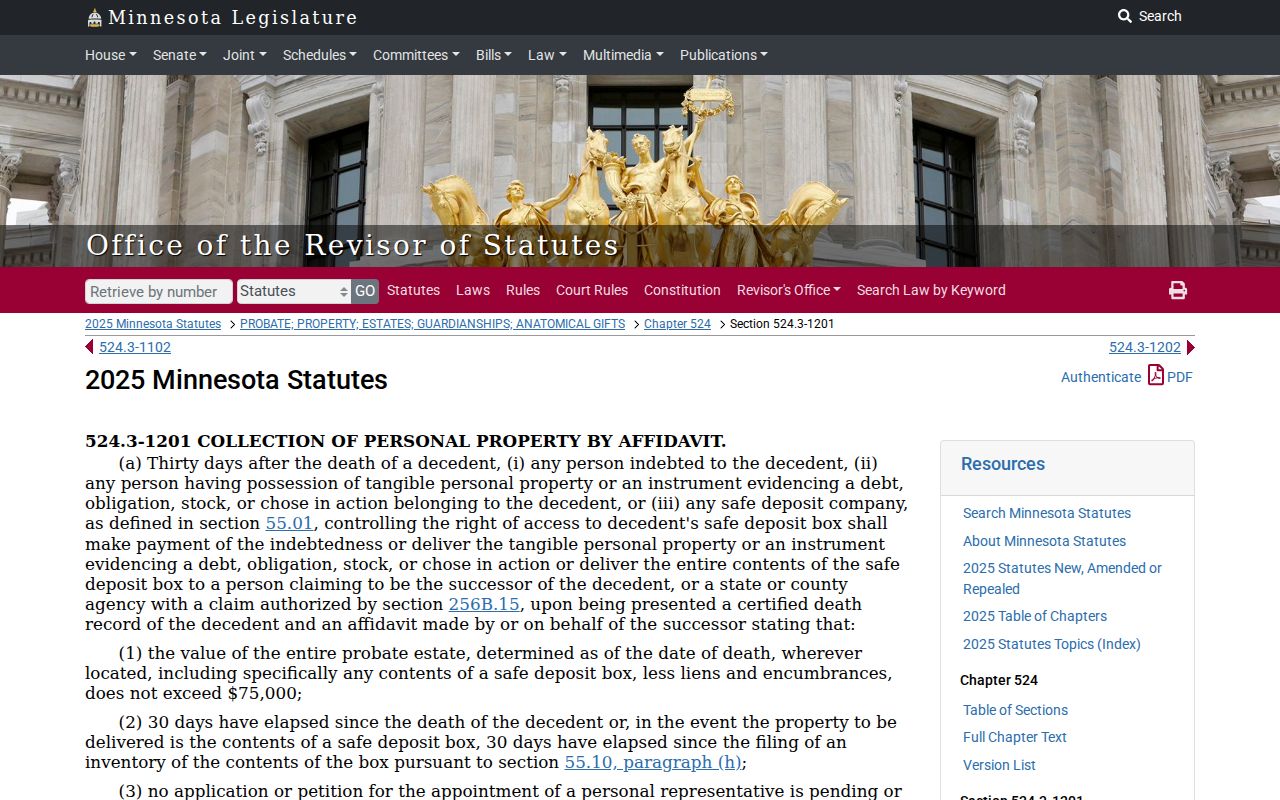
This statute provides a limited personal-property route and does not automatically resolve titled real estate, creditor disputes, or contested ownership.
Restricted Minnesota Probate Records
The Minnesota Rules of Public Access govern judicial probate records. Public case existence does not make every report downloadable. Inventories can expose private financial facts. Account numbers, medical evaluations, visitor reports, background studies, and protected-person data may be sealed, restricted, or redacted. Guardianship and conservatorship files receive added screening because they concern health, safety, personal care, and finances.
Ask for a named document, such as current Letters or a particular order, instead of the entire file. Court Administration can explain whether the requested item is public, available at a courthouse terminal, restricted to a party, or available only by court order. A county recorder may hold a later real-property instrument, but it does not replace the probate court case. Likewise, a death certificate comes through its lawful vital-record route.
Minnesota's statewide Judicial Branch leadership and court structure are documented in an official court announcement.
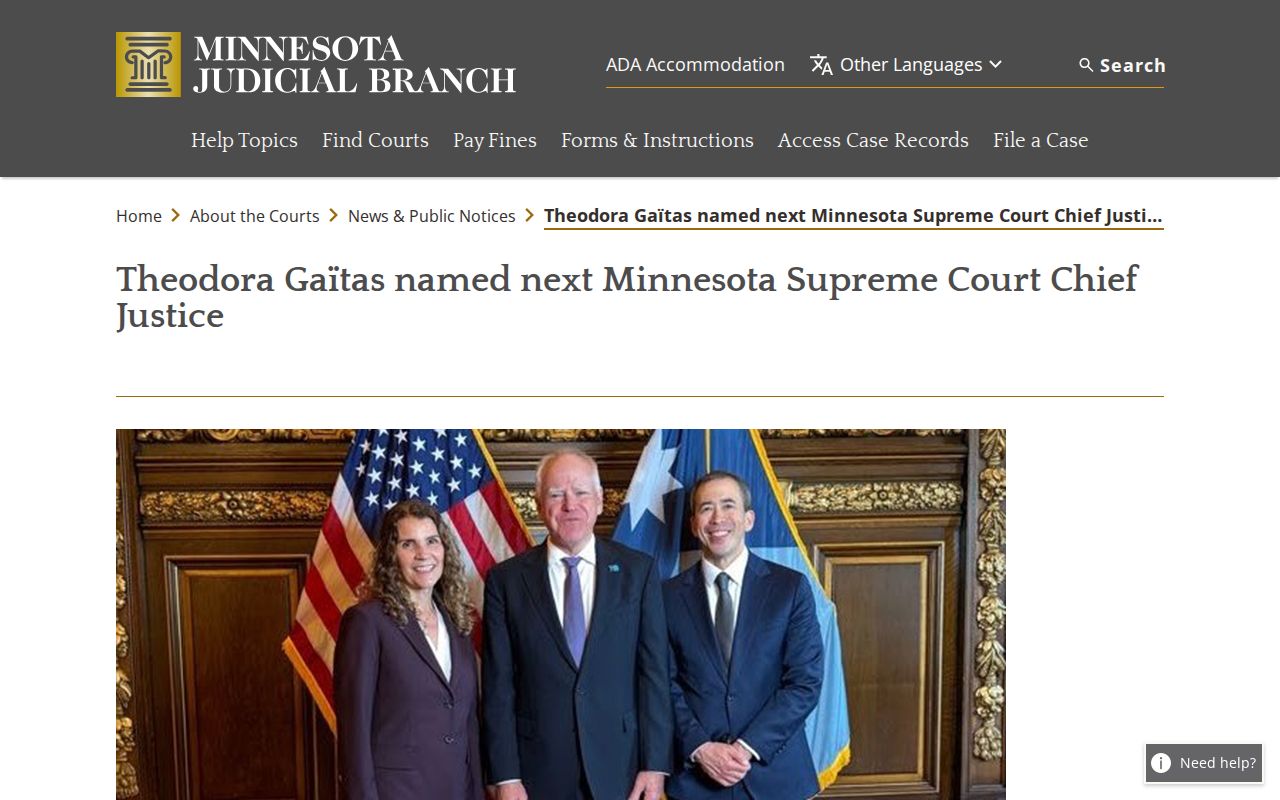
The statewide court source helps place every county Probate Division within one Minnesota Judicial Branch.
Find Minnesota Probate Records
Start with the county where the decedent was domiciled or the estate was opened. Search MCRO statewide, save the PR case number, then use the full directory of all 87 Minnesota counties for Probate Court Administration. For a mailed or in-person request, give the decedent, case number, exact will, order, Letters, inventory, or closing paper needed, the desired certification, return details, and a request for the current total.
Older Minnesota probate files may sit in local archives, microfilm, offsite storage, or a historical transfer. Ask the filing court where its index and packet went. Court staff can retrieve identified records but may not conduct open-ended genealogy or decide which paper proves a legal right. For current authority, ask whether the appointment remains active and whether recently certified Letters are available.
Note: Search statewide first, then rely on filing-county Court Administration to retrieve, screen, and certify the Minnesota probate record.