
Minnesota Arrest Records and Charges
Minnesota arrest records are agency records. Police or sheriff data can document the subject, arrest time and place, arresting agency, booking event, and initial reason for custody. Under Minnesota's system, the county or city prosecutor then reviews reports and may decline, divert, request more investigation, file a complaint, or pursue an indictment. Court Administration opens the District Court file only after a charging instrument reaches court.
The records therefore answer separate questions. The arrest record shows the law-enforcement event. A jail roster shows custody and intake allegations. The complaint shows counts approved for filing. The register shows later amendments, pleas, dismissals, and results. A recent subject may appear only in booking data, while a citation can become a case without any jail booking. Check Minnesota inmate records for current custody, then use the court source for filed charges after arrest.
Dates also need separate treatment. The incident, arrest, booking, complaint signature, filing, first appearance, plea, disposition, and sentence can occur on different days. Comparing those dates explains many apparent conflicts. A release from jail does not dismiss charges, and a declined filing can leave agency data without a District Court case.
Find Minnesota Arrest Records
No single portal contains every Minnesota arrest record and filed charge. Start with the arresting agency or county sheriff for booking and public response data. Use Minnesota Court Records Online for filed District Court counts. Pending criminal cases cannot be found remotely by defendant name, so use a case number, citation number, or attorney name and bar number. MNPAC courthouse terminals and filing-county Court Administration provide the fallback.
- Identify the arresting agency, county, date, and any booking, incident, citation, or case number.
- Use the county directory for the official sheriff roster, records unit, and District Court location.
- Search MCRO by case or citation number when charges have been filed.
- Read each count's statute, level, plea, amendment, disposition, and sentence, then request proof from its custodian.
For a Chapter 13 request, name the existing booking sheet, public arrest response data, release log, incident number, date range, and desired inspection or copy format. Ask for redaction and segregable public portions if some data is withheld. The prosecutor is a third custodian and may hold public charging data mixed with investigative, victim, witness, work-product, or security material. Request the filed complaint from Court Administration first.
A missing MCRO result has several possible causes: a pending defendant-name search, filing delay, spelling variation, wrong county, citation not yet processed, restricted case type, expungement, or an older nondigitized file. Use exact identifiers, then ask county Court Administration before concluding that no charge was filed.
Minnesota Charging Documents
Minnesota court charge records begin with the instrument that alleges an offense. Minnesota commonly uses complaints, citations, and indictments. An information is a useful national comparison term, but it should not replace the documents shown in Minnesota rules and dockets. Read the current document because later amendments and dismissals control over an original count title.
| Complaint | Information | Indictment | |
|---|---|---|---|
| Source | Prosecutor-signed sworn allegation of probable cause | Generic prosecutor instrument where authorized; not Minnesota's main label | Grand jury accusation |
| Minnesota use | Common for filed criminal counts | Do not assume a Minnesota case uses one | Specified serious prosecutions |
| Meaning | Alleges numbered counts and facts | Alleges charges without proving guilt | Authorizes prosecution but does not decide guilt |
Minnesota Court Charge Status
Each count has its own path. One can be amended while another is dismissed, continued for dismissal, acquitted, or resolved by guilty plea. A case can be closed even though the count results differ. Minnesota dockets may simply say dismissed instead of using the national phrase nolle prosequi. Read the exact event and order.
| Status | What It Means |
|---|---|
| Pending | No final count disposition is recorded; remote defendant-name search is blocked. |
| Amended | The statute, degree, description, or count changed; compare old and current entries. |
| Dismissed | The count ended without conviction, but other counts or cases may remain. |
| Convicted | A guilty plea or verdict produced judgment on that count. |
Minnesota Charges Versus Convictions
An arrest and filed charge are not findings of guilt. Probable cause supports process at an early stage, while conviction requires a guilty plea or proof beyond a reasonable doubt at trial. A sheriff roster's booking charge can change before filing. The disposition, not the arrest label or complaint alone, establishes the court result.
| Charge | Conviction | |
|---|---|---|
| Stage | Accusation | Verdict or plea |
| Burden of Proof | Probable cause | Beyond reasonable doubt |
| Best proof | Current complaint and count history | Certified disposition and sentence |
Minnesota Sealed Versus Expunged
Minnesota expungement seals qualifying records from ordinary public access. It does not destroy every trace. Automatic and petition-based routes differ by disposition, offense, waiting period, and other statutory factors. A petition under section 609A.03 goes to the District Court county where the case was resolved and must identify affected agencies so the order can define its reach.
| Sealed | Expunged | |
|---|---|---|
| Basis | Privacy rule, classification, or court order | Automatic provision or Chapter 609A order |
| Public effect | Record or document is withheld as directed | Covered records are sealed from ordinary disclosure |
| Agency access | Authorized access follows the governing rule | Statutory criminal-justice exceptions can remain |
Read Minnesota Charge Codes
A filed count can show its number, Minnesota statute and subdivision, offense title, severity, alleged date, tracking or citation number, plea, disposition, and sentence. Minnesota levels include felony, gross misdemeanor, misdemeanor, and petty misdemeanor. A petty misdemeanor is not a crime in the same manner as a misdemeanor, though it can produce a citation and court disposition. Severity describes legal exposure, not guilt.
Read the complaint in order: county and case number, defendant identity, count number, statute and subdivision, title and degree, offense date, probable-cause narrative, prosecutor signature, and judicial process action. Do not merge two people from a name match. Compare middle name, date of birth when lawfully shown, county, incident date, attorney, and linked case.
Minnesota Statewide Criminal History
The BCA Public Criminal History Search is Minnesota's compiled statewide repository. Its ordinary public search is conviction-limited. Public conviction data remains available for 15 years after sentence completion and may include offense, offense date, conviction court and date, sentence, level, and probation agency or place of confinement. Arrests, nonconviction matters, older completed convictions outside the window, and juvenile history do not appear in ordinary public results.
A subject may use the current BCA request process for additional information about self. Fees, signature, notarization, fingerprints, consent, and permitted scope depend on the current form and authorized program. A member of the public cannot turn the self-request route into unrestricted access to another person's arrest data. For the complaint and count-level file, return to filing-county Court Administration.
To correct a mismatch, first obtain the certified court disposition. Compare case number, count, disposition, sentence, and completion data with the BCA entry. Ask the court to correct only a court-source error; use BCA's official challenge process when the repository differs. An expungement order must be supplied to the agencies named under its terms, and downstream updates may take time.
Minnesota Arrest Data Access
Minnesota Statutes section 13.82 classifies law-enforcement response, incident, and investigative data. Public arrest response data and a court complaint can have different access status because the sheriff or police use Chapter 13 while judicial records use branch public-access rules. Ask the responsible authority for the exact existing record, public portions, and the legal classification supporting any denial.
Important: Formal employment, housing, or credit screening requires a lawful purpose, proper process, and an appropriate consumer-reporting product.
The official Minnesota law-enforcement data statute shows why arrest and investigation data require separate classification:
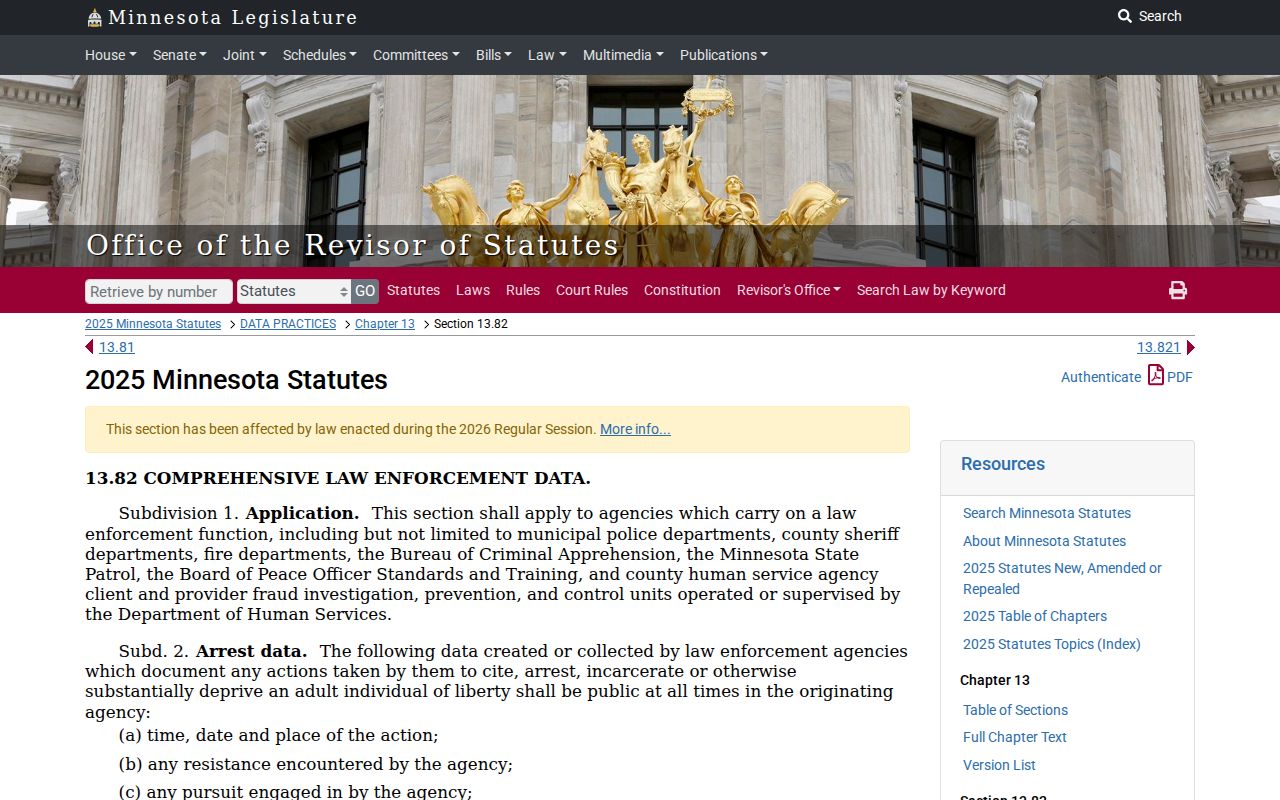
That classification does not decide whether the later District Court complaint is public.
Restricted Minnesota Charge Records
Juvenile court and criminal-history data are not ordinary adult records. Section 260B.171 limits juvenile court access, while section 299C.095 makes juvenile criminal-history data private except for authorized dissemination. Sealed or expunged records, active investigative data, victim and witness data, protected identifiers, and material restricted by court order may also be absent or redacted.
The official juvenile criminal-history restriction defines limits on BCA dissemination:
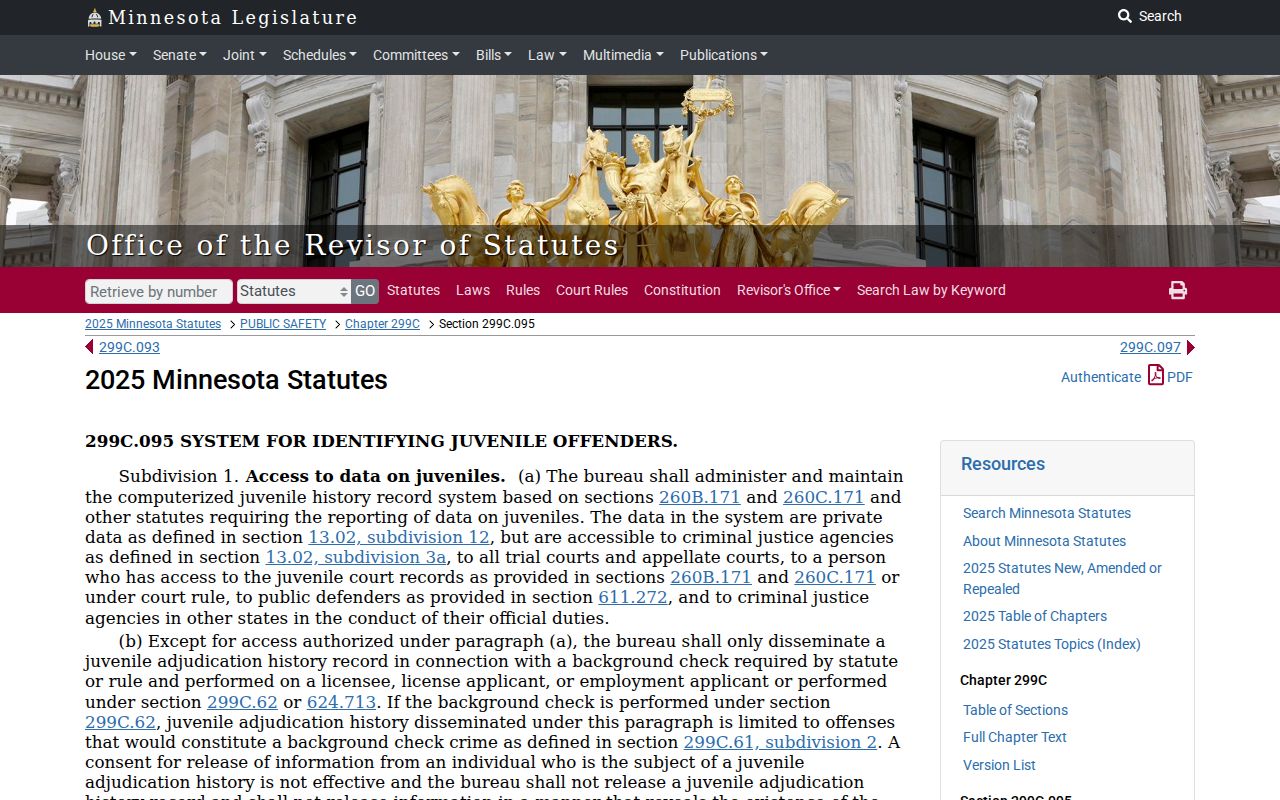
Adult-style public name search should not be used to bypass those protections.
The related Minnesota juvenile court records statute governs access to the court side:
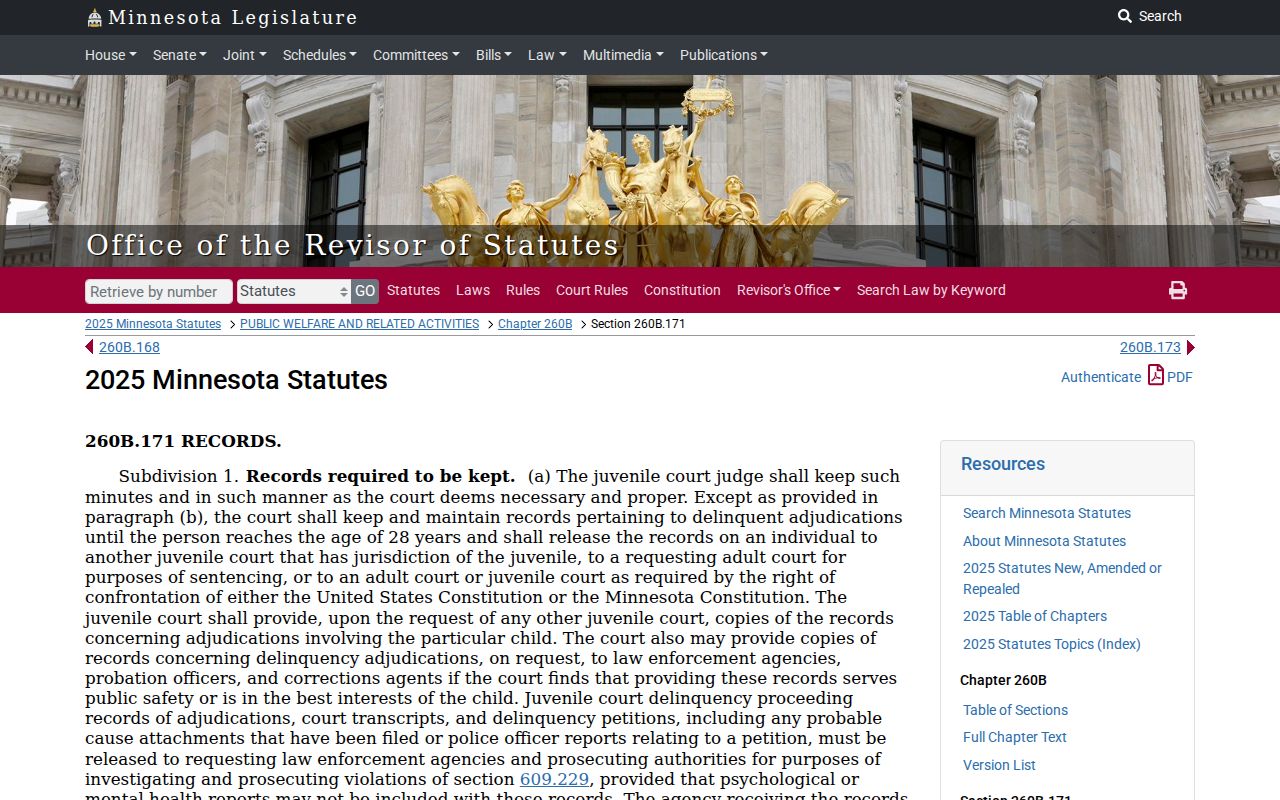
Authorized parties should contact Court Administration, prove identity or relationship, and follow the court's secured process.
Close the search with the custodian. Use the Minnesota county directory for the arresting sheriff or police agency, prosecutor, and District Court Administration. Save the date checked and exact identifiers. A blank result can mean filing delay, name-search restriction, wrong county, nondigitized material, or lawful restriction rather than no arrest or charge.
For legal proof, ask Court Administration for the certified complaint and certified disposition in the named case. The complaint establishes what was filed at that point; the disposition establishes how each count ended. Neither document by itself provides every police report, booking detail, prosecutor communication, federal case, or out-of-state event. Define the purpose before ordering so the correct custodian and record product are used.
Note: Minnesota court charges, sheriff booking allegations, and BCA public convictions may differ lawfully because each source covers a different stage and scope.