
Minnesota's Unified Court Administration
Minnesota does not use the split elected-clerk model found in some states. District Court Administration is part of the Minnesota Judicial Branch. A local Court Administrator manages the office that serves the District Court location and maintains its trial records. That unified office covers felony, gross-misdemeanor, misdemeanor, traffic, civil, family, juvenile, probate, conciliation, and housing cases. The system is statewide, but each filing county remains responsible for its locally stored paper, exhibits, archive, certifications, and case-specific corrections.
The Minnesota model separates court records from county government records. County vital-records or license offices issue and maintain marriage records. County recorders maintain land instruments. Sheriffs maintain jail booking and certain warrant or incident data. The Clerk of Appellate Courts maintains Minnesota Supreme Court and Court of Appeals files. Federal clerks handle federal cases. A request addressed only to a generic "county clerk" can therefore reach the wrong custodian.
Note: Minnesota Court Administration is a Judicial Branch office, even though its trial records remain tied to a county location.
Minnesota District Court Administration
District Court Administration maintains the register of actions, filed court documents, judgments, orders, exhibits under court control, and access copies for every ordinary Minnesota trial-case category. It accepts pleadings, assigns case numbers, schedules hearings, receipts court money, issues authorized process, and authenticates records. Staff can retrieve an identified public item and explain local request procedures. They cannot select the legally correct document for a requester, give legal advice, or replace a BCA criminal-history report, DOC inmate file, or DVS driver record.
- Criminal complaints, citations, appearances, pleas, orders, dispositions, sentences, and related court events.
- Civil pleadings, motions, hearings, judgments, garnishment events, and satisfactions.
- Family petitions, decrees, custody and support orders, subject to confidential-data rules.
- Probate, guardianship, conservatorship, juvenile, eviction, and Conciliation Court files within access limits.
- Plain, certified, and exemplified court copies, plus identified public register-of-actions records.
Court Administrator Records and Duties
One Minnesota District Court Administration office covers all ordinary trial-court case types in its filing location. The table separates the record from the clerk's action so a requester can describe the product precisely. It also makes clear which noncourt products require another agency.
| Record / Case Type | District Court Administration Duty |
|---|---|
| Criminal and traffic court files | Maintain filings and events; issue eligible plain or certified copies |
| Civil, housing, and conciliation cases | Maintain pleadings, orders, judgments, and satisfaction events |
| Family, divorce, and custody cases | Maintain public court portions and screen restricted child or financial data |
| Probate and protected-person matters | Maintain probate cases and apply access limits to sensitive reports |
| Marriage certificates | Not held; contact the issuing county's license or vital-records office |
| Land and deed records | Not held; contact the county recorder |
| Appellate records | Trial-level appeal events only; use the Clerk of Appellate Courts for the appellate file |
What Minnesota Court Clerks Do
Court Administration connects each Minnesota trial file to the statewide case-management system and the local record. The office receives court papers, records activity, calendars proceedings, maintains judgments, and applies the Minnesota Rules of Public Access to requests. Staff also distinguish remote public access from courthouse access. A document missing in MCRO may still be public through MNPAC or the filing counter. A confidential document does not become public because its event label appears.
- Accept authorized filings and assign or maintain the case number.
- Maintain the official case file and chronological register of actions.
- Schedule hearings and issue summonses, writs, and other process as authorized.
- Collect and receipt filing fees, fines, and court-ordered payments.
- Produce plain, certified, or exemplified copies of eligible court documents.
- Support electronic filing and access while protecting confidential information.
A plain copy reproduces a filed public document. A certified copy adds the clerk or court certification often required for a legal transaction. An exemplified or authenticated copy adds further certification and may be needed for interstate or foreign use. An apostille can be a separate step. A transcript is produced through a court reporter or transcription process, not as an ordinary copy-counter service.
Note: Ask the receiving organization which authentication it requires before ordering a certified, exemplified, or apostilled Minnesota record.
Request Certified Minnesota Court Copies
Start with MCRO to locate the case number, county, document title, and docket date. Then use the filing county's District Court Administration, since a courthouse elsewhere cannot necessarily certify another location's paper or archived item. State whether a plain, certified, or exemplified copy is needed and whether attachments must be included. Ask the receiving agency which form of authentication it accepts before paying.
- Locate the case and save its full number, filing county, parties, and exact document title or event date.
- Open the county directory and reach that location's official District Court Administration page.
- Ask whether the item is public, remote, archived, or subject to identity proof or a court order.
- Specify plain, certified, or exemplified copies, attachments, delivery method, and a maximum authorized cost.
- Obtain the page count, certification charge, delivery cost, accepted payment method, and total.
- Submit the official form or written request through the locally accepted in-person, mail, or secure electronic channel.
- Inspect the received certification, case number, names, and included pages before using the record.
Phone contact is useful for a quote, archive location, and payment instructions, but staff generally will not read an entire case file aloud. Email acceptance varies. Never send card data through ordinary email unless the office provides an approved secure method. For appellate files, repeat the process with the Clerk of Appellate Courts and P-MACS.
Minnesota Copy Request Fields
A complete Minnesota court-copy request helps the clerk locate the exact item and quote it without guessing. If the case number is unknown, give full names as used during the case, an approximate year, case type, and county. Avoid Social Security numbers, complete financial accounts, or unnecessary health information. Staff need record identifiers, not extra sensitive data.
| Field | Required | Notes |
|---|---|---|
| Case number | Strongly preferred | Use the complete Minnesota number with location, class, year, and sequence. |
| County and party names | Yes | Identify the filing location and names used in the case. |
| Filing year or date range | If number unknown | Narrows a name search and archive request. |
| Documents requested | Yes | Name the complaint, order, decree, judgment, transcript, or other exact item. |
| Copy type | Yes | Choose plain, certified, or exemplified and state whether attachments are included. |
| Requester contact | Expected | Name, mailing address, phone, and email support quote and delivery. |
| Delivery and payment | Conditional | Follow the office's accepted pickup, mail, secure delivery, and payment process. |
Note: A complete case number and exact docket title reduce search time, page-count uncertainty, and the risk of ordering the wrong filing.
Minnesota Court Clerk Fees
Minnesota does not support one universal quote for every court request. The District Court fee statute lists a $310 component for an ordinary civil first paper, but law-library and other authorized surcharges can increase the courthouse total. Filing posture also matters. Plain copies are commonly priced per page, while certification or exemplification adds another charge. The filing office should quote the actual page count and current total.
| Item | Amount |
|---|---|
| MCRO public search and available PDFs | Free; downloaded papers are not certified |
| Plain court copy | Per-page or local branch schedule; request a quote |
| Certified court copy | Copy charge plus certification; request a quote |
| Exemplified or authenticated copy | Copy plus added authentication; confirm need and total |
| Ordinary civil first paper | $310 statutory component, not the final courthouse total |
| Archive retrieval or delivery | Varies by file location and local method |
Indigent litigants may apply for a fee waiver through Minnesota's current court forms. A judge reviews income, benefits, expenses, dependents, and inability to pay. A waiver does not automatically erase every vendor, service, transcript, or outside-agency fee unless the law or order covers it. Ask for an itemized amount and never mail cash unless the office expressly permits it.
Minnesota Court Clerk Forms
The Minnesota Judicial Branch forms library organizes statewide forms by topic. The statewide Copy Request Form identifies the requester, case, county, desired documents, authentication, delivery, and payment information. A local court can require additional steps based on archive location or payment method. eFiling forms serve a different purpose and should not be mistaken for a public-record order.
- Court Copy Request Form for an identified plain, certified, or exemplified court document.
- Statewide Court Forms for case-specific filings and fee-waiver materials.
- Expungement Forms for qualifying criminal-record sealing petitions and related service papers.
Marriage and land forms come from county government, not Court Administration. The Minnesota Office of Vital Records routes people to the appropriate vital-record source.
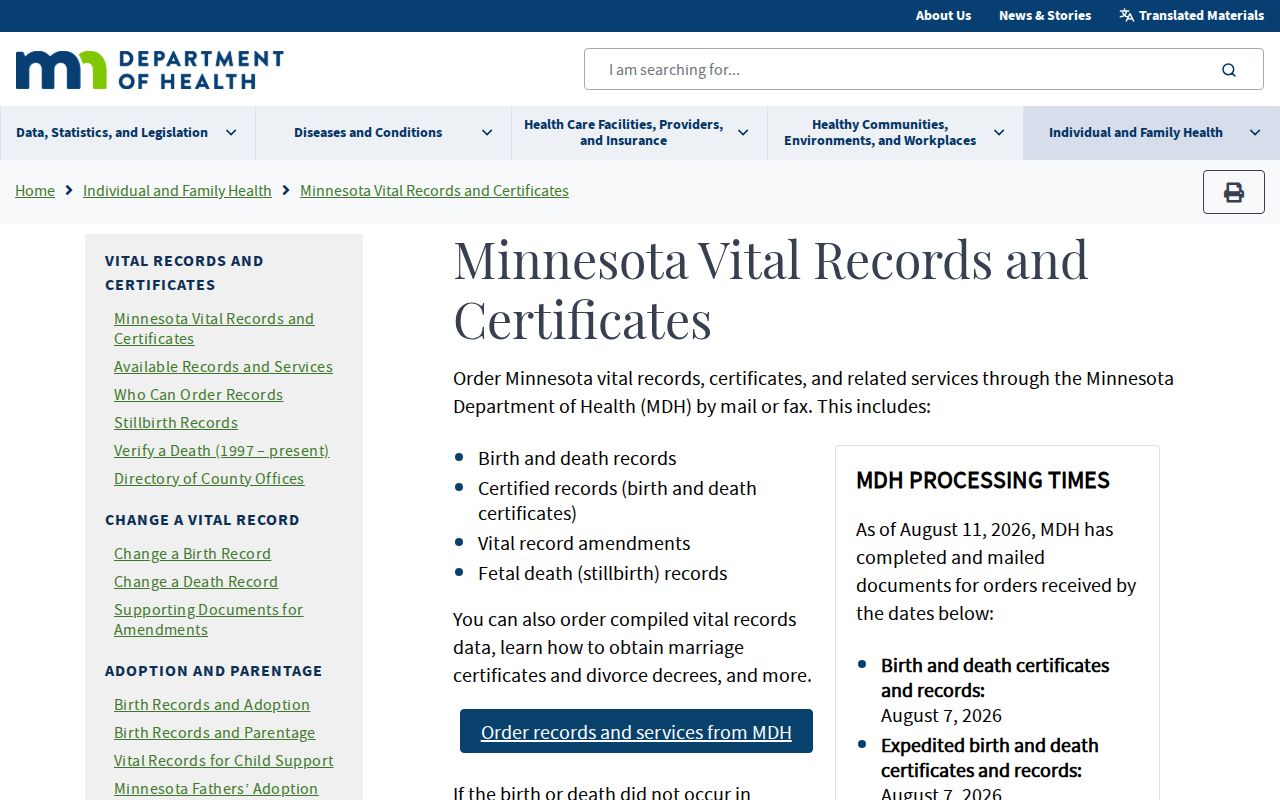
Minnesota's state health office does not issue marriage or divorce records. Marriage certificates come from the issuing county, while divorce decrees come from the granting District Court.
Minnesota Mail and Online Channels
MCRO is the public viewing system. MNPAC is the public courthouse terminal. eFile and eServe, or eFS, is the statewide filing and service system. MGA is restricted government-subscriber access. These systems are not interchangeable. Attorneys, government agencies, guardians ad litem, and other mandatory filers use eFS statewide under the applicable rules; self-represented litigants may file electronically when eligible. Opening an eFS account does not order a court copy.
Mail a copy form or a precise written request to the filing court only after confirming the total and payment method. In-person counter access works for locally held public paper and certification. Phone helps with estimates, archives, and accepted delivery. Some offices accept email or secure electronic delivery, but Minnesota does not promise a single local practice. MNPAC at any District courthouse can show statewide electronic public information, while the filing office remains the source for local physical material.
Note: eFS submits court filings; it is not a public search tool or a shortcut for purchasing a certified copy.
Find Minnesota Court Administration
Browse the directory of all 87 Minnesota counties to reach the official District Court Administration office for the filing location. The county route supplies current address, phone, counter hours, local payment methods, and any archive or delivery instructions. Statewide infrastructure does not mean any courthouse can certify every local exhibit or old volume. If a matter was transferred, ask both the original and receiving office which holds the requested document.
A representative Minnesota court records center shows how MCRO, courthouse terminals, mail, and copy requests can work together.
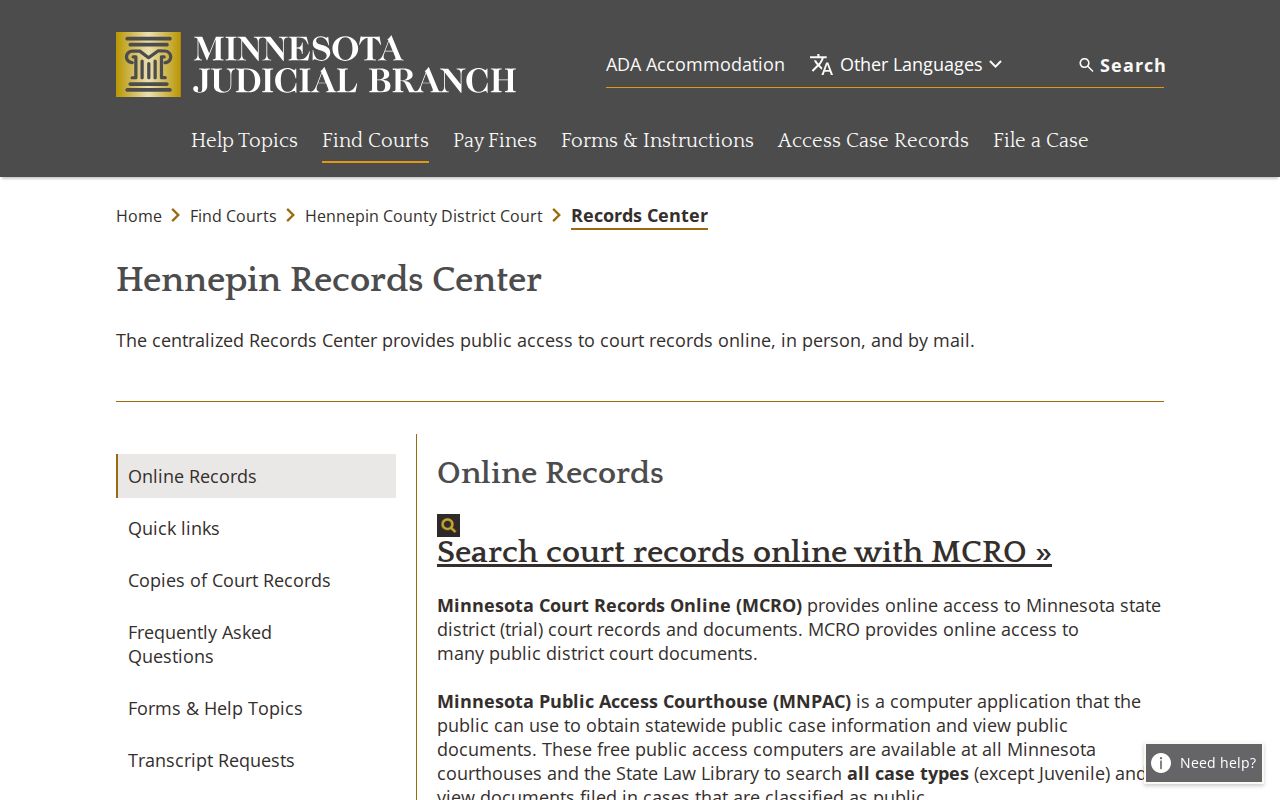
Local details vary across Minnesota, so that example should not replace the official page for the county where the case was filed.
Note: Ask for the exact court document and copy type; Court Administration cannot choose which legal paper a requester needs.