
Minnesota Marriage and Divorce Custodians
Minnesota draws a firm office line. The county office that issued the marriage license records the completed certificate and provides certified copies. Minnesota District Court grants a dissolution, and Court Administration in the granting county holds the Judgment and Decree and case file. The Minnesota Department of Health Office of Vital Records does not record marriages or divorces. MOMS is a multi-county finding index, not a certificate issuer or divorce-status database.
Quick Reference:
New license or certified certificate: The issuing county's license or vital-records office.
Marriage index lead: MOMS for participating counties, followed by the issuing county.
Divorce file or certified decree: Court Administration in the county that granted dissolution.
MDH Office of Vital Records: No Minnesota marriage or divorce certificates are held there.
| Record | Original Issuing / Filing Office | Certified Copy Source |
|---|---|---|
| Marriage license | Authorized Minnesota county office | Issuing county |
| Marriage certificate | Issuing county after officiant return | Issuing county |
| Marriage index entry | MOMS data from participating counties | Index only; not certified proof |
| Divorce petition and case file | Minnesota District Court | Granting county Court Administration |
| Judgment and Decree | Minnesota District Court | Granting county Court Administration |
Using the wrong Minnesota office causes a failed request. MDH cannot convert a MOMS entry into a certificate, and a county marriage office cannot certify a District Court divorce decree.
Minnesota Marriage License Process
An authorized Minnesota county office accepts the application, verifies identity and statutory information, collects the fee, and issues the license. County procedures can include online preapplication, appointments, and local payment rules. Certificate orders may be accepted in person, by mail, by phone, or through a county-authorized online service, depending on that office. Applicants should confirm identification, appearance rules, validity period, and current methods before visiting. The Minnesota county directory identifies the local route.
Minnesota has abolished its former five-day waiting period, but applicants should rely on current county and statutory directions. After solemnization by an authorized officiant, the officiant completes and returns the certificate to the issuing county within the required period. The county then records it. That lifecycle explains why the issuing office, not the ceremony site or MDH, is the certificate custodian.
Apply for Minnesota Marriage Licenses
Minn. Stat. §517.08 controls core application information, the statutory license fee, and the reduced fee for applicants who complete qualifying premarital education. A county may add scheduling and accepted-payment instructions, so check its official application page.
- Select an authorized Minnesota county office and review its preapplication, appointment, and identification instructions.
- Provide both applicants' statutory data, identification, and any required facts about prior marriages.
- Submit a qualifying premarital-education statement if seeking the reduced statutory fee.
- Sign or swear to the application as the county directs and pay its current total.
- Have an authorized officiant solemnize the marriage while the license is valid.
- Ensure the officiant returns the completed certificate to the issuing county, then order certified copies there.
The applicant should retain the issuing county and license number. Those details make the later Minnesota certificate search faster and avoid confusing the place of ceremony with the office that recorded the marriage.
Minnesota Marriage Application Fields
County application screens can vary, but Minnesota law calls for core identity, eligibility, and name information. Confidential data belongs in the designated field and should not be treated as a public index value. A county may ask for added workflow details without changing which office owns the record.
- Identity and residence: Legal name, address, county and state, date and place of birth, and age for each applicant.
- Confidential identity: Social Security number if assigned, entered in the designated nonpublic field.
- Prior marriage: Date and manner of termination when applicable.
- Name choice: The legal name requested after marriage.
- Conditional disclosures: Statutory felony and name-change questions.
- Completion: Photo identification, qualifying education statement if used, and required signature or oath.
Public MOMS results do not display every application field. Social Security numbers and other confidential data remain outside the public index even though the issuing county collected them lawfully.
Minnesota Marriage and Divorce Fees
Minnesota's marriage license fee and qualifying education reduction come from §517.08, but applicants should verify the present amount, payment method, and any county procedure at the issuing office. MOMS is a free index. County certificate charges vary. Divorce filing and court-copy totals depend on statutory components, county law-library surcharges, page count, certification, and delivery. Court Administration should quote the exact request.
| Item | Amount | Where Paid |
|---|---|---|
| MOMS marriage index search | Free | MOMS |
| Marriage license | Statutory full or qualifying reduced fee; verify current amount | Issuing county |
| Certified marriage certificate | Varies by county | Issuing county |
| Divorce filing | Statutory and local components; obtain current total | Filing-county Court Administration |
| Plain divorce-file copy | Per-page or local branch schedule | Granting-county Court Administration |
| Certified Judgment and Decree | Copy plus certification charge | Granting-county Court Administration |
An eligible divorce litigant may apply for a court fee waiver. The judge reviews income, benefits, expenses, and ability to pay, but an order may not cover every outside service or delivery cost.
Search Minnesota Marriage Records
Minnesota Official Marriage System, or MOMS, searches records supplied by most participating counties. Fields include each applicant's first, middle, and last name, county, and marriage-date range. Results can identify applicants, date, county, and a record number where displayed. Use names as they appeared at marriage and try spelling variants or a wider date range.
| MOMS Field | Required | Search Use |
|---|---|---|
| Applicant 1 first, middle, last | A name is needed | Use the name at marriage and historical spelling |
| Applicant 2 first, middle, last | Optional | Narrows results for the couple |
| County | Optional | Choose a participating county or search statewide |
| Marriage date from / to | Optional | Narrows the event range |
| Search / Clear | Not applicable | Runs or resets the query |
MOMS participation and coverage can change. No result does not prove there was no marriage. The county may not participate, a historical name may differ, or the record may be in a local archive. Contact likely counties or a historical repository, then obtain legal proof from the issuing county. MOMS cannot establish whether a later divorce occurred.
The statutory framework for Minnesota marriage records appears in the official marriage-license source.
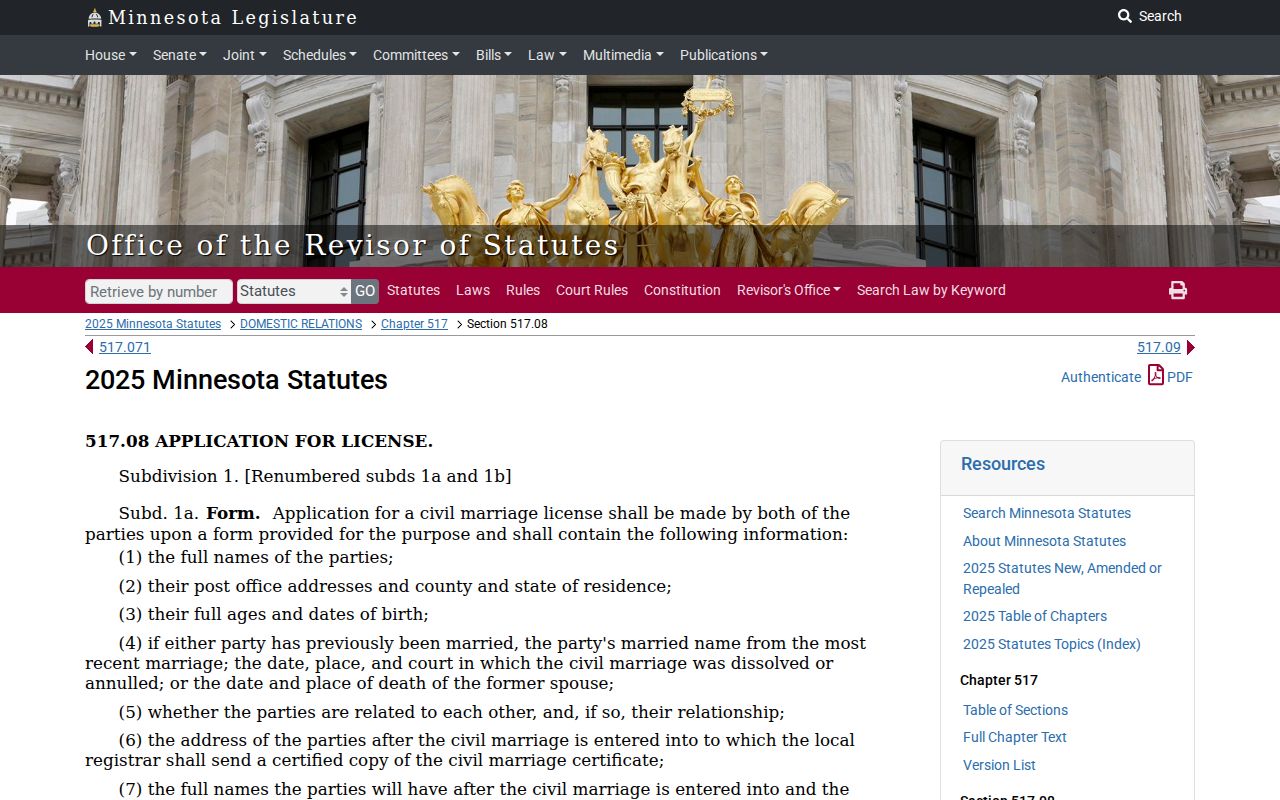
This source ties the county application and license process to Minnesota law rather than an MDH certificate system.
Search Minnesota Divorce Records
Use MCRO to search a public Minnesota District Court family case by party, case number, and county. Verify that the disposition shows dissolution granted and locate the Judgment and Decree event. Remote family-document access can be limited. MNPAC at a courthouse provides a fuller public view, while granting-county Court Administration handles old files, mailed or in-person copy requests, phone quotes, public papers not downloadable online, and certification. P-MACS is the separate channel if the case was appealed.
A divorce file can contain the summons and petition, affidavits, temporary orders, financial and parenting material, settlement, decree, and later motions. Confidential forms, protected child data, and some financial records are segregated or restricted. The Judgment and Decree is the final legal instrument most people need. A marriage certificate proves the recorded marriage, not its dissolution.
Minnesota uses no-fault dissolution based on irretrievable breakdown. At least one spouse generally must satisfy the 180-day Minnesota residency or domicile rule before the case starts, subject to statutory exceptions. The case may begin jointly or with a summons and petition. Filing, service, response, temporary relief, financial disclosure, child-focused processes, settlement or trial, findings, decree entry, and later enforcement or modification create distinct records.
Fee-waiver forms, interpreter services, and domestic-violence safety procedures are available through the court process when applicable. Minnesota Court Self-Help can explain forms, but it cannot choose strategy. A legal separation, annulment, or post-decree motion is not the same event as an initial dissolution, so confirm the case classification and the exact final order.
Order Minnesota Certified Records
A certified Minnesota marriage certificate comes from the county that issued and recorded the license. Provide both spouses' names at marriage, date and place, issuing county, license or record number if known, requester and mailing details, copy quantity, payment, delivery choice, signature, and identification when required. For foreign use, ask about Secretary of State apostille steps after obtaining a suitable county-certified record.
A certified divorce Judgment and Decree comes from Court Administration in the county that granted dissolution. Find the FA case in MCRO, save its complete number, and identify the decree and any amendment or later order needed. A downloadable PDF may not meet an agency's certification rule. Ask for page count, certification, delivery, and the total before paying.
- Decide whether the needed proof is a marriage certificate or a divorce Judgment and Decree.
- Identify the issuing marriage county or the District Court county that granted dissolution.
- Gather names at the event, date, county, and license, record, or court case number.
- Ask the correct county office for its form, identification rule, total, certification, and delivery options.
- Inspect the received copy for the correct names, record number, seal, and attachments.
Minnesota Vital Records Office
The Minnesota Department of Health Office of Vital Records is the statewide vital-records office, but Minnesota assigns marriage and divorce custody elsewhere. MDH does not record marriages or divorces and does not issue those certificates. Its role here is to direct requesters to local Minnesota registrars and the court system. No MDH marriage or divorce year range, requester class, or certified abstract exists to publish.
The official MDH marriage and divorce custody statement sends marriage requests to the county that issued the license and divorce requests to the District Court that granted the decree. That is also the source shown below.
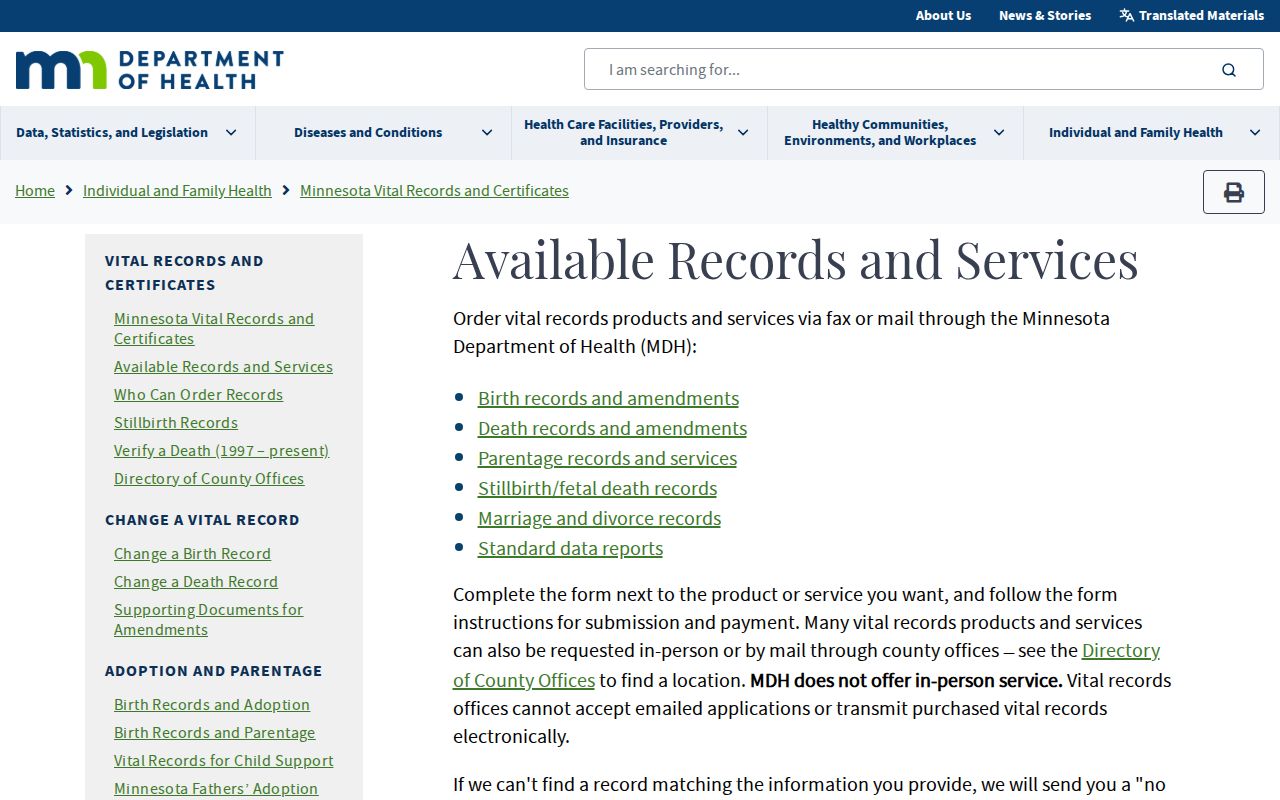
The state guidance confirms that MDH cannot replace either Minnesota county custodian.
Which office: Order a marriage certificate from the issuing county. Order a certified divorce decree from granting-county Court Administration. MDH holds neither.
Minnesota Department of Health, Office of Vital Records
State guidance and local registrar directory
No marriage or divorce certificates issued
Find Minnesota Record Custodians
Marriage records stay with the Minnesota county office that issued the license. Divorce records stay with District Court Administration in the county that entered the Judgment and Decree. Choose the event county in the full directory of all 87 Minnesota counties, then select the official marriage license or court-record contact. For an old file, ask about indexes, microfilm, offsite storage, or archive transfer. A missing online result is not proof that no record exists.
Note: Ask for the exact document and certification rather than a broad search, especially when confidential financial or child data must be screened.